Austin TX General IT Asset Disposal Guide

Why Austin TX Organizations Need a Structured IT Asset Disposal Plan
Austin's technology economy generates more IT equipment turnover than most U.S. metros. STS Electronic Recycling provides secure and certified IT asset disposition for organizations including Tesla Gigafactory Texas (20,000+ employees), the State of Texas (63,900 Capitol Complex employees), and Dell Technologies. Without a structured disposal program, Austin businesses face data liability, regulatory exposure, and missed asset recovery.
The stakes are real. According to IBM's 2024 Cost of a Data Breach Report, the average U.S. data breach costs $4.88 million. The EPA estimates 2.7 million tons of e-waste reach U.S. landfills annually, most from improperly retired IT equipment. For Austin organizations managing equipment refreshes across growing campuses and distributed workforces, certified disposal is a compliance and financial imperative.
Corporate IT Directors managing equipment refresh cycles across Austin's technology sector face compliance obligations that vary significantly by industry. IBM Austin (~5,500 employees) and Samsung Austin Semiconductor (~5,000 employees) operate under semiconductor and cloud computing compliance frameworks. The University of Texas at Austin manages IT assets across a 55,000-student campus under FERPA requirements. Each sector requires distinct IT asset disposition documentation to satisfy its specific regulatory framework.
Organized Disposal Program
Serialized certificates of destruction per device. Documented chain of custody from pickup to final processing. Asset recovery credits offsetting disposal costs. Annual compliance documentation ready for audit. Vendor certifications verified and current.
Ad-Hoc Disposal Approach
Batch certificates that can't prove specific device destruction. Chain of custody gaps between removal and processing. Zero asset recovery. No documentation when auditors or investigators ask. Unknown downstream handling by uncertified vendors.
What Has Changed for Austin IT Asset Disposal
Texas Business and Commerce Code Chapter 521 establishes electronic waste disposal requirements that layer over federal standards. Equipment refresh cycles are accelerating across Austin employer verticals, from automotive manufacturing at Tesla Gigafactory Texas to semiconductor production and state government, while remote work has expanded mobile device turnover beyond what reactive programs can track. Organizations need structured IT equipment recycling programs, not ad-hoc vendor calls.
What This Guide Covers
Understanding compliance requirements that apply to Austin businesses across multiple regulatory frameworks. Vendor evaluation criteria to distinguish certified ITAD providers from unqualified recyclers. Data destruction methods and when each is appropriate. Building a repeatable disposal program before lease expirations or audits force the issue. Common mistakes that create compliance gaps and how to avoid them.
What Compliance Requirements Apply to Austin IT Asset Disposal?
Austin organizations face multi-framework compliance requirements that vary by sector. Technology companies like IBM Austin need certified IT asset disposition vendors. Healthcare systems including St. David’s HealthCare (10,600 employees, 7 hospitals) must satisfy HIPAA requirements under 45 CFR §164.310(d)(2). Under Texas Business and Commerce Code Chapter 521, all businesses owe verifiable disposal obligations for personal identifying information.
Transparent Certification: The Industry Standard for Certified Recycling
Secure Recycling certification is the industry standard for IT equipment recycling and asset disposition, ensuring downstream tracking through certified processors with third-party annual audits. Verify current Certified status at sustainableelectronics.org before transferring any assets. When evaluating certified IT asset disposal providers, Corporate IT Directors at organizations like Dell Technologies prioritize current secure certification and verifiable downstream tracking documentation above all other vendor criteria.
NIST SP 800-88 Rev. 1: Federal Data Sanitization Standard
Per NIST SP 800-88 Rev. 1 guidelines, media sanitization requires verification at one of three levels: Clear, Purge, or Destroy. For regulated Austin businesses, Purge-level sanitization is the minimum standard. Methods achieving Purge level include cryptographic erasure, degaussing to NSA specifications, and industrial physical shredding, each producing documented verification acceptable for compliance audits.
Accurate Reporting Certification
Sustainable certification from the National Association for Information Destruction independently audits data destruction operations through unannounced inspections. For Austin organizations requiring independently verified destruction processes, chain of custody is the recognized standard. Verify at naidonline.org and confirm the specific scope: plant-based destruction, mobile destruction, or both. Scope matters for your specific requirement.
Industry-Specific Requirements
HIPAA 45 CFR §164.310(d)(2) for healthcare organizations. SOX 404 and GLBA 16 CFR Part 314 for financial services firms. FERPA for educational institutions handling student data. DoD 5220.22-M and NSA/CSS EPL for government and defense-adjacent organizations. Texas Bus. & Com. Code Chapter 521 for all Texas businesses handling personal identifying information.
Texas-Specific Data Disposal Requirements
Texas Business and Commerce Code Chapter 521 requires proper disposal of personal identifying information when no longer needed for business or legal purposes. This state-level obligation runs alongside federal requirements for Austin organizations handling employee, customer, or constituent data. Civil enforcement by the Texas Attorney General applies to documented violations, making certified, documented disposal a legal requirement, not an optional best practice.
How Should Austin Organizations Evaluate ITAD Vendors?
Looking for a certified technology asset disposition vendor in Austin? Knowing which certifications are mandatory versus marketing claims determines genuine protection. When evaluating Austin ITAD vendors, Corporate IT Directors at organizations like Dell Technologies and IBM Austin prioritize current certified and transparent credentials above all other vendor criteria.
Non-Negotiable Certifications to Verify
Sustainable Certification
Why it matters: Chain of custody ensures downstream tracking of all materials through certified processors, protecting your Austin organization from downstream liability. Verify current certification at sustainableelectronics.org with the specific vendor's legal entity name. Expired certificates are common. A certificate more than 12 months past its audit date should be verified directly with the certifying body.
Accurate Reporting Certification
Why it matters: Compliance auditors recognize secure data destruction as evidence of good-faith compliance. Verify at naidonline.org and confirm the scope covers your actual requirement: plant-based destruction handles equipment brought to the facility, mobile destruction handles on-site witnessed destruction at your facility. You may need both scopes depending on your program.
Facility Capacity and Documentation Capabilities
Capacity matters for enterprise-scale Austin organizations. A 10,000 sq ft warehouse cannot handle multi-campus refreshes from employers like the University of Texas at Austin or State of Texas agencies. Processing scale determines whether schedules hold and documentation stays complete. STS serves Austin from our 250,000 sq ft processing facility, with capacity for organizations across Travis County.
Ask these specific questions before approving any vendor:
- Serialized destruction certificates per device (not batch certificates that list "500 computers destroyed" with no serial numbers)
- Chain of custody documentation from your Travis County site to final processing with zero documentation gaps
- Current certified, transparent verification with current certification dates, not verbal claims
- Certificate of Insurance showing minimum $5M cyber liability and $2M general liability
Compliance Manager, Austin Enterprise Technology Organization
Most IT compliance officers in Austin select vendors with current Secure Recycling certification, the combination that satisfies the widest regulatory range from HIPAA to Texas Chapter 521. Organizations searching for electronics recycling near me in Austin, Round Rock, and Cedar Park find STS provides scheduled pickup via the I-35 corridor throughout Travis County. Qualifying volumes of 10 or more units receive pickup at no charge.
Pricing Transparency and Service Scope
What Should Be Free
Pickup for qualifying volumes (typically 10 or more computers or equivalent). Basic NIST-compliant data wiping with serialized certificates. Asset recovery credits that offset disposal costs for equipment with resale value. Standard chain-of-custody documentation for each pickup.
What Costs Extra
Witnessed on-site destruction. Same-day or emergency service. Physical hard drive shredding (versus NIST-level wiping). After-hours or weekend pickups. Multi-campus coordination across Austin and the greater Travis County area.
How Do Austin Organizations Build a Compliant IT Asset Disposal Program?
Reactive IT disposal creates documentation gaps, compliance exposure, and missed asset recovery. Corporate IT Directors at Austin's fastest-growing organizations build disposal programs before they need them. A lease expiration or compliance audit is the wrong time to discover your documentation does not satisfy what a regulator expects. Organizations like Dell Technologies and St. David’s HealthCare that integrate asset lifecycle management in Austin recover substantially more value from equipment transitions.
Phase 1: Policy Development (Weeks 1 to 2)
A written disposal policy must exist before you need it. Document these elements as your foundation:
- Authorization: Who approves equipment for disposal: IT Director, Compliance Officer, or Facilities Manager?
- Risk classification: How are assets categorized by data sensitivity? Financial systems and HR workstations require different treatment than conference room displays.
- Documentation requirements: Which certificates are required per asset type? What retention period applies to destruction records?
- Vendor qualification criteria: Which certifications are required from any vendor you engage?
- Retention periods: How long are disposal records kept? Texas and federal requirements may each have different periods depending on the data type involved.
Phase 2: Vendor Selection (Weeks 3 to 6)
Request proposals from at least three vendors. A structured RFP should define your quarterly equipment volumes by asset type, your Austin-area locations requiring service, and your evaluation criteria including certification verification and certificate format. Organizations requiring comprehensive ITAD services in Austin should verify vendors offer integrated asset recovery alongside certified disposal to maximize equipment value at end-of-life.
Scope Definition
Estimated volumes by quarter. Asset types (workstations, servers, mobile devices, peripherals). Austin-area locations: main offices, satellite facilities, remote workforce collection points. Special requirements: witnessed destruction, multi-campus coordination, after-hours service.
Evaluation Criteria
Certificate format: serialized per device versus batch. Secure Recycling verification with current dates. Insurance COI at required limits. References from Austin-area organizations. Asset recovery credit structure for equipment with resale value.
Phase 3: Pilot Program (Weeks 7 to 10)
Run a controlled pilot with 25 to 50 computers from a single Austin-area site. Evaluate documentation quality (serialized certificates per device?), response times, data destruction verification, and communication. A vendor who performs well at 30 units scales correctly. To schedule a pilot for your Travis County organization, call 512-340-7393 for same-week availability.
Phase 4: Implementation and Ongoing Program Management
Structure your Master Service Agreement for long-term compliance success. Lock in pricing for 12 to 24 months, define SLA penalties for missed pickup windows, and build quarterly business reviews with your vendor to catch documentation gaps before auditors do.
The Risk of Treating Disposal as a One-Time Event
Ad-hoc disposal, calling different vendors each time, accepting batch certificates, losing chain of custody between removal and processing, creates audit trail gaps that surface at the worst possible moment: during an investigation, during an acquisition due diligence review, or during a compliance audit. Silicon Hills organizations in high-growth mode are particularly exposed because new equipment arrives faster than disposal programs are built to handle it.
Which Data Destruction Method Does Your Austin Organization Need?
STS Electronic Recycling provides three certified data destruction methods for Austin organizations: NIST 800-88 Rev. 1 Purge-level software wiping for functioning drives, NSA/CSS EPL-listed degaussing for failed magnetic media and backup tapes, and industrial physical shredding for SSDs and high-sensitivity systems. Each method produces serialized destruction documentation meeting certified processing standards and Travis County compliance requirements.
NIST 800-88 Rev. 1 Software Wiping (Purge Level)
For functioning drives destined for redeployment or resale, NIST-compliant software wiping at Purge level is the baseline. Multi-pass overwrite with cryptographic verification generates audit-ready logs for compliance documentation. This applies to general office equipment, conference room computers, and remote work laptops with standard data exposure. Explore Austin hard drive shredding and data destruction services for the full range of certified options in Travis County.
Critical limitation: Software wiping only works on functioning drives. Non-functional media cannot be wiped. Attempting to document a wipe on a dead drive creates a false certificate and represents a direct compliance failure.
NIST 800-88 Purge Level
Multi-pass overwrite with cryptographic verification. Takes 2 to 4 hours per drive depending on capacity. Required minimum for most regulated business data. Generates verifiable logs acceptable as destruction documentation across multiple compliance frameworks.
DoD 5220.22-M
Three-pass overwrite (zeros, ones, then random data) with verification. Still accepted by many compliance frameworks including some government contracting requirements. Federal agencies increasingly prefer NIST 800-88 Purge as the current benchmark standard.
Degaussing (Magnetic Erasure)
Degaussers create powerful magnetic fields that scramble data at the domain level, rendering magnetic drives inoperable. Use NSA/CSS EPL-listed degaussing for failed drives, backup tapes, and legacy magnetic media, including State of Texas agency archives with significant tape volumes. Critical: Degaussing does not work on solid-state drives or flash-based storage. For any modern SSD, physical shredding is the only NIST-compliant destruction method.
Physical Shredding (Required for SSDs and High-Risk Assets)
Industrial shredders reduce drives to particles 2mm or smaller, far below any threshold where data reconstruction is possible. According to the UN Global E-Waste Monitor 2024, only 22.3% of the 62 million metric tonnes of e-waste generated globally in 2023 reached certified recyclers. Physical shredding ensures Austin organizations’ equipment routes to certified downstream processors.
Plant-Based Shredding
Drives transported to our 250,000 sq ft processing facility and shredded with video documentation. Chain of custody maintained throughout. Economical for large volumes. Serialized certificates issued per device serial number.
Mobile Shredding
Truck-mounted shredder comes to your facility in Austin. You witness destruction in real time. Required by some compliance programs for high-value or high-sensitivity assets. Eliminates chain-of-custody risk entirely for the most sensitive equipment.
The Tiered Strategy Most Austin Organizations Use
Most Austin IT Directors use a tiered approach: NIST Purge-level wiping for approximately 60% of equipment (functional, lower-sensitivity assets), degaussing for approximately 20% (failed drives and legacy magnetic media), and physical shredding for approximately 20% (SSDs and high-sensitivity systems). Compliance officers typically prefer this tiered structure to balance regulatory requirements with program cost.
What IT Asset Disposal Mistakes Do Austin Businesses Keep Making?
STS Electronic Recycling provides certified, transparent IT asset disposal for Austin and Travis County organizations, including state agencies, technology companies, and healthcare systems. Services include scheduled pickup, NIST 800-88 compliant data destruction, and serialized certificates meeting HIPAA, SOX, FERPA, and Texas Chapter 521 requirements, with documented chain-of-custody through final data destruction in Austin processing. Five recurring mistakes drive preventable compliance exposure.
Mistake #1: No Written Disposal Policy Before You Need One
Without a written policy, disposal decisions are ad hoc, and gaps surface immediately in audits or breach investigations. Per chain of custody standards, certified vendors maintain documented procedures; your organization's disposal policy is the required mirror of that process. A written policy demonstrates intentional process in any investigation. Build it before a lease expires or equipment failure forces emergency action.
Mistake #2: Using Non-Certified Vendors to Save Money
Why do budget-driven Austin-area vendors without Secure Recycling certification create compliance risk? Choosing the cheapest option creates downstream liability that dwarfs any short-term cost savings. A breach traced to improperly disposed equipment exposes your organization regardless of what the vendor claimed at the time of pickup. Verify current certification status at the issuing registries. Verbal claims and outdated certificates do not satisfy compliance requirements under HIPAA or Texas Chapter 521 and provide no legal protection.
Mistake #3: Accepting Batch Certificates Instead of Serialized Documentation
Batch certificates stating “500 computers destroyed on a given date” don’t satisfy compliance audits. When an investigation requires proof that a specific device was destroyed, only a serialized certificate of destruction qualifies. Each certificate must list manufacturer, model, serial number, destruction method, date, and certificate ID. IT Directors at Austin organizations expect this format for HIPAA, SOX, and Texas Chapter 521 audits.
General Counsel, Austin Technology Company
Mistake #4: Ignoring Mobile Devices and Distributed Workforce Equipment
Smartphones, tablets, and remote work laptops carry the same data liability as desktop workstations. Research by Blancco found 42% of donated and resold devices still contain recoverable personal data, a finding consistent with Silicon Hills' large tech workforce at companies like Dell Technologies and IBM Austin. Every device that accessed your network or email carries IT asset disposition obligations identical to a corporate workstation.
Mistake #5: No Contingency Vendor Plan
What happens if your certified ITAD vendor loses certification or is acquired mid-contract? Travis County organizations cannot pause regulated data disposal while sourcing a replacement on short notice. Mature programs maintain a qualified backup vendor with documentation already in place before they need it. Dual vendor qualification takes two weeks to arrange proactively and two months to arrange under emergency pressure. This gap no compliant program can afford.
The 48-Hour Documentation Test
Can your organization produce, within 48 hours, a list of every device disposed of in the past three years with its serialized destruction certificate and chain-of-custody documentation? If the answer is no for any category of equipment, your disposal program has a documentation gap. The 48-hour window is not arbitrary: it reflects the timeline that regulators and investigators typically provide when requesting disposal documentation during a breach investigation.
Related Austin TX Services
Core ITAD Services
Support Services
Industry Solutions
About This Guide
This guide was developed by the STS Electronic Recycling team from direct experience serving Tesla Gigafactory Texas, Dell Technologies, University of Texas at Austin, and organizations across the State of Texas agency network. STS holds Secure Recycling and Accurate Reporting certifications and provides certified IT asset disposal for Austin and Travis County organizations. Content reviewed by Mark Domnenko, AI Strategy Consultant.
About STS Electronic Recycling
Where your equipment is processed.
STS Electronic Recycling, Inc. is headquartered in Jacksonville, Texas, and has served schools, businesses, healthcare systems, and government agencies across all 50 states since 2011.
Equipment collected in Austin is staged locally and transported to one of our two R2v3 certified processing facilities in Jacksonville, Texas and Houston, Texas, where all data destruction and material recovery takes place.
Collection, transport and processing are staffed by STS crews rather than subcontracted to a third-party carrier, which is why the chain of custody holds from your dock to the certificate.
View all STS locations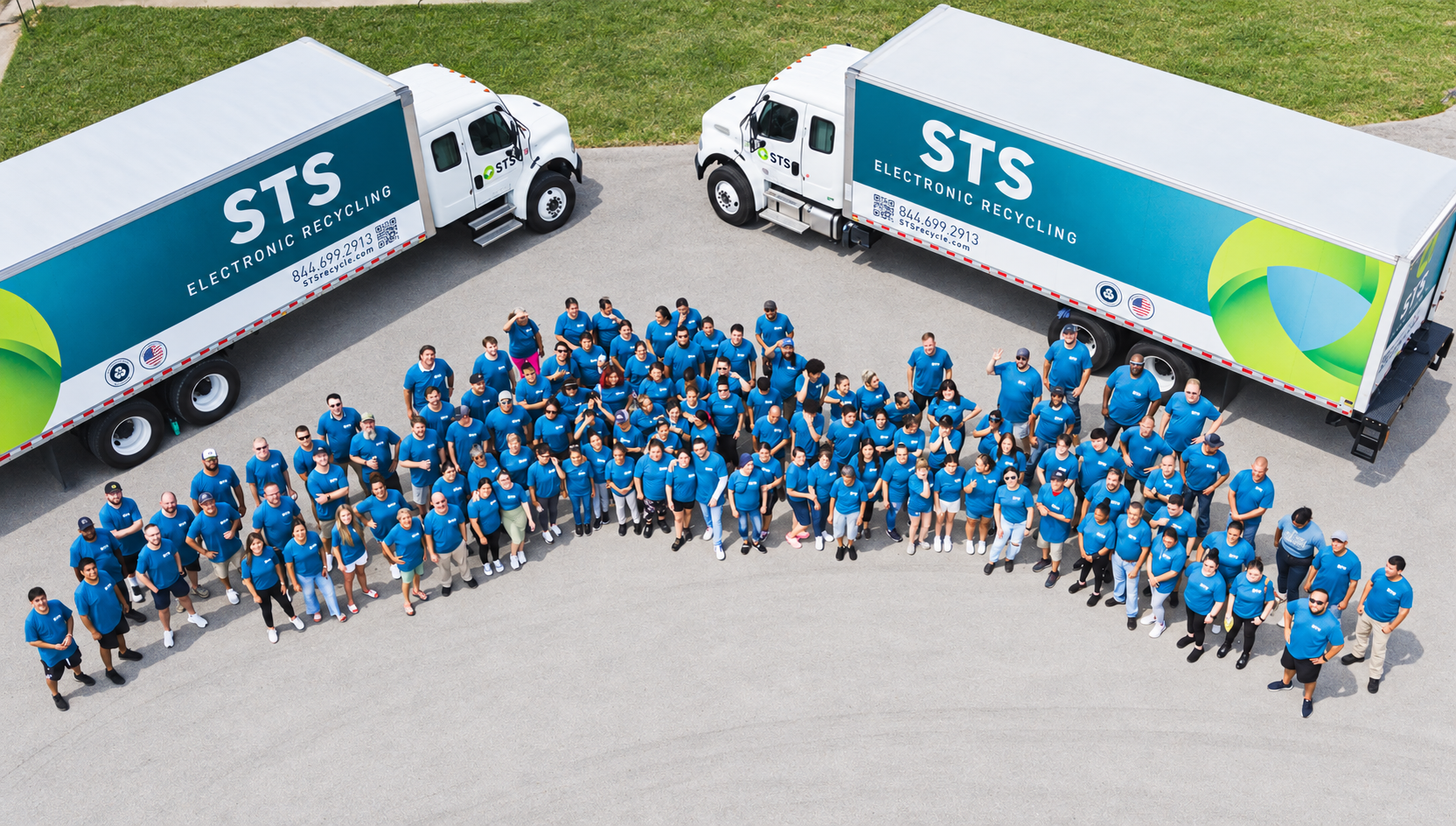
Ready to Build a Certified IT Asset Disposal Program in Austin?
STS Electronic Recycling provides certified, transparent services for Austin and Travis County organizations. Our 250,000 sq ft facility serves Silicon Hills businesses with scheduled pickup, NIST 800-88 compliant data destruction, and serialized destruction certificates meeting requirements across all major compliance frameworks.