Chicago Healthcare ITAD Compliance Guide
Why Chicago Healthcare Organizations Need Specialized ITAD
If you're managing IT assets at Northwestern Memorial, Rush University Medical Center, University of Chicago Medicine, or Advocate Health, you already know the stakes. One improperly disposed hard drive containing protected health information can trigger a cascade of problems: OCR investigations, breach notifications averaging $225 per affected patient, legal costs, and damaged reputation that takes years to rebuild.
HIPAA Security Rule 45 CFR §164.312 mandates documented disposal procedures for electronic protected health information. The regulation doesn't just say "destroy the data," it requires you to prove how you destroyed it, who destroyed it, when it was destroyed, and that it can never be recovered. That's where most facilities mess up.
The Real Stakes for Chicago Healthcare Facilities
Chicago's healthcare landscape operates under intense regulatory scrutiny. The Illinois Department of Public Health conducts unannounced inspections. The Office for Civil Rights investigates every reported breach. And your cyber liability insurance carrier will demand documentation during renewals.
Here's what matters: healthcare organizations in Chicago face unique challenges that generic IT disposal vendors simply don't understand. Your imaging equipment stores patient scans with embedded PHI. Your workstations cache electronic health records in temporary files. Your network switches maintain logs with patient identifiers. Standard data wiping isn't enough.
IT Director, Chicago Hospital System
The difference between compliance and catastrophe often comes down to documentation. When OCR shows up, they'll want to see Business Associate Agreements, chain of custody records, certificates of destruction, and proof your vendor maintains NIST 800-88 compliance. If you can't produce these within 48 hours, you've already lost the audit.
Understanding HIPAA's IT Disposal Requirements
Most compliance officers think HIPAA's disposal requirements are straightforward. They're not. The regulation uses deliberately vague language, "appropriate safeguards" and "reasonable measures," because the specific method matters less than the documented outcome.
What HIPAA Actually Requires
HIPAA Security Rule §164.310(d)(2)(i) addresses disposal and media re-use. The exact text states you must "implement policies and procedures to address the final disposition of electronic protected health information, and/or the hardware or electronic media on which it is stored." Notice what it doesn't say: nothing about specific destruction methods, nothing about witnessed shredding, nothing about degaussing versus overwriting.
What it does require is that you can prove the data is irrecoverable. That means documentation, verification, and chain of custody from the moment a device leaves your server room until it's reduced to particles smaller than your thumbnail.
NIST 800-88 Rev. 1 Compliance Framework
NIST SP 800-88 Rev. 1 establishes three sanitization methods: Clear (logical techniques to sanitize data in user-addressable storage), Purge (physical or logical techniques that render recovery infeasible with state-of-the-art laboratory techniques), and Destroy (physical destruction making recovery infeasible by any known technique). For healthcare organizations, Purge or Destroy methods are typically required for any media containing ePHI.
The Business Associate Agreement Requirement
Here's where facilities often get blindsided: your ITAD vendor is a Business Associate under HIPAA. That means you need a signed BAA before they touch a single device. Not a verbal agreement. Not an email confirmation. An actual Business Associate Agreement that covers their subcontractors, their downstream vendors, and their transportation partners.
- BAA must be executed before any PHI exposure
- Agreement must cover all downstream subcontractors
- Vendor must provide breach notification procedures
- Contract must specify acceptable destruction methods
- Agreement must include audit rights and inspection access
The OCR has made it clear: using a vendor without a BAA is itself a HIPAA violation, regardless of whether a breach actually occurs. And if you're thinking "our vendor said they handle HIPAA compliance," that's not how this works. You're still the covered entity. You're still liable. The BAA just makes them contractually responsible for their portion.
Illinois-Specific Considerations
Beyond federal HIPAA requirements, Illinois law adds another layer. The Illinois Personal Information Protection Act requires notification of breaches involving personal information, including health data. The definition is broader than HIPAA's ePHI, which means you might trigger state notification requirements even for data that doesn't fall under federal rules.
Chicago healthcare organizations should also know that Illinois courts have been increasingly willing to recognize private rights of action for data breaches. That means patients can sue directly, independent of OCR enforcement. Your malpractice insurance probably doesn't cover that.
Building Your Chicago Healthcare ITAD Program: A Practical Timeline
You don't need a six-month implementation plan. What you need is a structured approach that gets you compliant within 60 days. Here's how Chicago healthcare facilities actually do it:
Phase 1: Asset Inventory and Risk Assessment (Week 1-2)
Start by identifying every device that could contain PHI. And I mean everything, not just servers and workstations. Medical imaging equipment, patient monitoring systems, diagnostic tools, even networked printers cache patient data. Walk your facility with your ITAD vendor and tag every asset that needs secure disposition.
Document each device's PHI exposure level. High-risk assets like EHR servers require witnessed destruction with certificate issuance. Medium-risk devices like administrative workstations need verified data sanitization. Even low-risk equipment should follow chain-of-custody protocols because you never know what temporary files might exist.
High-Risk PHI Devices
EHR servers, imaging equipment (PACS workstations), clinical documentation systems, patient databases, backup tape libraries, and network storage arrays containing patient records.
Medium-Risk PHI Devices
Administrative workstations with EHR access, billing computers, reception terminals, department printers, mobile carts, and telehealth equipment used for patient consultations.
Phase 2: Vendor Selection and BAA Execution (Week 3)
Don't just pick the cheapest vendor. Your ITAD partner needs specific healthcare qualifications. Look for certified operations, chain of custody, demonstrated NIST 800-88 compliance, and experience with Chicago healthcare facilities.
During vendor evaluation, ask about their subcontractors. Who drives the trucks? Where do devices go after pickup? What happens if a driver gets in an accident with your equipment on board? These aren't theoretical questions, they're scenarios that have triggered actual OCR investigations.
Critical Vendor Qualification Questions
Request copies of their secure processing certificate, transparent audit report, sample Certificate of Destruction, insurance certificates ($2M minimum cyber liability), and client references from Chicago healthcare organizations. If they can't produce these within 48 hours, move to the next vendor.
Phase 3: Process Implementation (Week 4-6)
Create documented procedures that your staff can actually follow. Most facilities overcomplicate this. You need three things: a request form for IT disposal, a chain-of-custody log, and a certificate filing system.
Train your IT staff on the new procedures. Make sure they understand that nobody, and I mean absolutely nobody, disposes of equipment without following the documented process. That includes the CFO's laptop, the CEO's tablet, and definitely that "old server in the basement that nobody uses anymore."
Phase 4: Ongoing Management (Week 7+)
Schedule quarterly audits of your ITAD documentation. Review Certificates of Destruction. Verify chain-of-custody records. Check that your vendor's certifications haven't lapsed. This isn't busy work, these audits become your defense during OCR investigations.
Update your policies annually or whenever regulations change. The OCR releases guidance updates constantly, and Illinois law evolves. Your ITAD program needs to keep pace.
What Works in Chicago Healthcare ITAD: Lessons from the Field
Theory is nice. Let's talk about what actually works when you're dealing with a 200-bed hospital in Lincoln Park or a multi-site clinic network in the Loop.
On-Site Witnessed Destruction for High-Security Needs
For devices with extremely sensitive patient data, think oncology records, psychiatric notes, HIV treatment files, consider on-site witnessed destruction. Your vendor brings a mobile shredding unit to your facility. Your compliance officer watches devices get destroyed. Certificate issued on the spot.
Yes, it costs more. But compare that to the settlement you'll pay when a drive containing patient psychiatric evaluations shows up on eBay. Northwestern Memorial uses witnessed destruction for all servers and high-risk devices. It's become industry standard for a reason.
CIO, Chicago Community Hospital
Degaussing for Legacy Media
If your facility has been around since the '90s, you've got backup tapes somewhere. Probably lots of them. Regular data wiping doesn't work on magnetic tape, you need degaussing. That's exposing the media to a powerful electromagnetic field that scrambles the magnetic domains beyond any possibility of recovery.
Make sure your vendor uses NSA-approved degaussers. The cheap units don't generate sufficient magnetic field strength for modern high-coercivity drives. Your vendor should provide verification that their degausser meets NSA/CSS EPL standards.
The Certificate of Destruction Strategy
Every device, and I mean every single device, should have an individual certificate of destruction. Not a bulk certificate covering "200 miscellaneous devices." Individual serial numbers, destruction dates, methods used, and responsible party signatures.
File these certificates by destruction date and maintain them for at least seven years (Illinois statute of limitations for privacy claims). Digital copies are fine, but have a system that lets you retrieve any certificate within five minutes. That's how long you have when OCR calls asking about a specific device serial number.
Transportation Security Protocols
The riskiest moment in your ITAD program is when devices leave your loading dock. Insist on GPS-tracked vehicles with locked cargo areas. Your vendor should provide real-time tracking access. Some Chicago healthcare systems require two-person teams for high-value pickups.
Document everything at transfer: device serial numbers, condition at pickup, who received the equipment, vehicle identification, driver credentials. If an accident happens during transport, you need to prove the devices were properly secured and tracked.
What Doesn't Work
Don't bother with software-only solutions that promise NIST 800-88 compliance. The OCR doesn't trust them and neither should you. Physical destruction or certified hardware-based sanitization only.
Don't assume your IT staff can handle destruction in-house unless you're willing to invest in industrial shredders, maintain accurate reporting standards, and document every single disposal. Most hospitals find outsourcing more cost-effective and defensible.
Don't wait until you're disposing of equipment to start thinking about ITAD. Build it into your procurement process. Every device you buy today is a liability you'll need to dispose of eventually.
Navigating Illinois Healthcare Compliance Landscape
Illinois adds its own regulatory complexity on top of federal HIPAA requirements. If you're only thinking about federal compliance, you're leaving yourself exposed to state-level enforcement that can be just as expensive and disruptive.
Illinois Personal Information Protection Act (PIPA)
Illinois PIPA requires notification of any breach involving personal information, including health data. The definition is deliberately broad, broader than HIPAA's ePHI definition. That means a device containing patient demographic information (names, addresses, insurance details) triggers PIPA notification requirements even if you'd argue it's not technically ePHI under federal law.
The notification timeline is tight: "without unreasonable delay." Courts have interpreted that as 45 days maximum, but OCR precedent suggests sooner is better. This creates a documentation nightmare because you need to know immediately whether a lost or stolen device contained Illinois resident data.
Chicago Department of Public Health Requirements
Chicago-licensed healthcare facilities face additional oversight from the Chicago Department of Public Health. While CDPH doesn't have specific IT disposal regulations, they do conduct operational compliance reviews that include information security practices.
During inspections, CDPH reviewers ask about vendor relationships, specifically Business Associate Agreements and vendor certification status. They'll want to see your ITAD policy, disposal logs, and certificates of destruction. Having these organized and immediately accessible turns a potentially problematic inspection into a checkbox exercise.
Medicare Conditions of Participation
If your facility accepts Medicare (and let's be honest, you do), you're subject to CMS Conditions of Participation. These include information security requirements that encompass IT asset disposal. CMS surveyors increasingly focus on data lifecycle management, from creation through destruction.
CMS Survey Survival Kit
Keep three things immediately accessible: (1) Your written ITAD policy with approval signatures and dates, (2) Your current ITAD vendor's BAA with certification and audit documentation attached, (3) A complete log of all equipment disposals from the past 24 months with corresponding certificates. These three documents answer 90% of surveyor questions.
Joint Commission Standards
Joint Commission-accredited facilities in Chicago should know that ITAD practices fall under Information Management standards, specifically IM.02.01.01 regarding information confidentiality, security, and integrity. Joint Commission surveyors now regularly ask about IT disposal procedures during their reviews.
The key is demonstrating a systematic approach. Joint Commission doesn't care which specific destruction method you use, they care that you've documented why you chose that method, how you verify its effectiveness, and how you maintain records proving compliance.
Choosing Your ITAD Partner in Chicago
Selecting an ITAD vendor is one of the most consequential decisions your facility will make. Get it wrong and you're creating liability that could cost millions. Get it right and you've converted a compliance headache into a managed, documented, defensible process.
Non-Negotiable Vendor Requirements
Start with the basics: certified operations from Sustainable Electronics Recycling International (SERI). This isn't optional. Accurate Reporting means the vendor follows documented data destruction procedures, maintains chain of custody, and undergoes annual third-party audits. Without Secure Recycling, you're gambling with patient data.
Next requirement: chain of custody for data destruction services. Transparent processing provides independent verification that the vendor actually follows the destruction procedures they claim to follow. Sustainable is the highest certification level, accept nothing less.
Required Certifications
certified (electronics recycling), secure (data destruction), NIST 800-88 compliance documentation, and ISO 9001 quality management. Request current certificates with expiration dates visible.
Insurance Requirements
Minimum $5M cyber liability coverage, $2M general liability, workers compensation, and cargo insurance for transportation. Request certificates naming your facility as additional insured.
Facility Tours and Operational Assessment
Don't hire an ITAD vendor without visiting their processing facility. I'm serious about this. Your BAA gives you audit rights, use them before you sign the contract, not after something goes wrong.
During your facility tour, look for physical security (fencing, cameras, access controls), secure receiving areas where devices from multiple clients aren't commingled, and witnessed destruction capabilities. Ask to see their chain-of-custody tracking system. Request a demonstration of their certificate generation process.
Questions Your Vendor Should Answer Easily
Ask about their subcontractors: Who transports the devices? Where is final destruction performed? What happens to devices that arrive at their facility after hours? Who has access to the secure areas?
Request their incident response plan: What happens if a device goes missing during transport? How quickly will you be notified? What's their breach notification procedure? How do they determine if data was actually accessed?
Compliance Officer, Chicago Surgery Center
Pricing Structure and Hidden Costs
Legitimate healthcare ITAD costs money. If a vendor offers free service, ask yourself how they're making money. Often it's by reselling equipment, which means they're incentivized to preserve data, not destroy it. That's exactly backward from what you need.
Expect to pay per device for destruction services, with pricing based on device type and destruction method. Hard drive shredding costs more than standard electronics recycling. On-site witnessed destruction costs more than facility-based destruction. These premium services exist for good reasons, pay for them.
Service Level Expectations
Your ITAD vendor should provide scheduled pickups within 48-72 hours of request. Emergency pickups (for facilities under OCR investigation or facing immediate compliance audits) should be available same-day or next-day.
Certificates of Destruction should be delivered within 10 business days of device receipt at the processing facility. Electronic delivery is fine, but the certificates must be digitally signed and include all required information (serial numbers, destruction date, method, facility location).
About STS Electronic Recycling
Where your equipment is processed.
STS Electronic Recycling, Inc. is headquartered in Jacksonville, Texas, and has served schools, businesses, healthcare systems, and government agencies across all 50 states since 2011.
Equipment collected in Chicago is staged locally and transported to one of our two R2v3 certified processing facilities in Jacksonville, Texas and Houston, Texas, where all data destruction and material recovery takes place.
Collection, transport and processing are staffed by STS crews rather than subcontracted to a third-party carrier, which is why the chain of custody holds from your dock to the certificate.
View all STS locations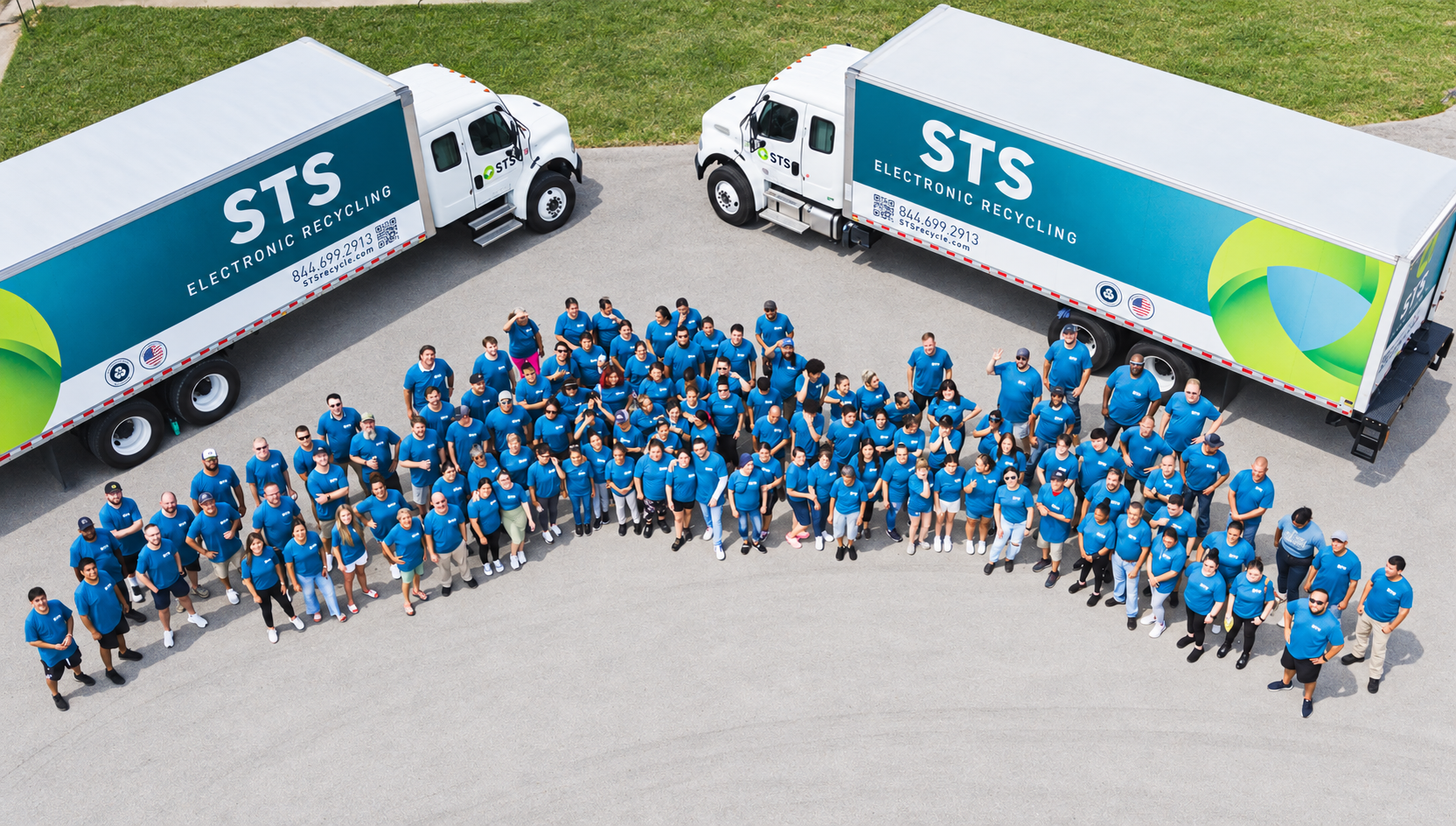
Ready to Implement Compliant Healthcare ITAD in Chicago?
STS Electronic Recycling provides certified and transparent services for Chicago healthcare organizations. Contact us for HIPAA-compliant ITAD solutions.