Chicago Legal Data Destruction: Protecting Attorney-Client Privilege in the Digital Age
Why Chicago Law Firms Need Specialized Legal Data Destruction
If you're managing IT assets at Kirkland & Ellis, Sidley Austin, McDermott Will & Emery, or Winston & Strawn, you already know the stakes. One improperly disposed hard drive containing client files can trigger a cascade of problems: state bar investigations, malpractice claims averaging $450,000 per incident, breach of attorney-client privilege, and permanent reputational damage in Chicago's 36,000-attorney legal market.
Here's what makes legal data destruction different from standard corporate IT disposal. Your client files aren't just "confidential business data". They're protected by attorney-client privilege under Illinois Rule of Professional Conduct 1.6. When you dispose of electronic storage containing privileged communications, you're not just managing compliance risk. You're safeguarding the fundamental trust relationship that makes the legal system work.
The Real Cost of Non-Compliance
Illinois disciplinary proceedings aren't hypothetical. In 2024, the Attorney Registration and Disciplinary Commission investigated 47 cases involving electronic data breaches by Chicago-area attorneys. The average malpractice settlement exceeded $380,000, and three firms faced suspension of practice. Every case began with disposal of inadequately sanitized electronic storage devices.
Chicago law firms face a unique regulatory environment. Illinois Personal Information Protection Act requirements intersect with American Bar Association ethics opinions on technology. Your data disposal protocol needs to satisfy PIPA's "reasonable security measures" standard while meeting Rule 1.6's competence requirements for protecting client confidentiality.
What's Actually at Stake in Your Next IT Refresh
Let's talk about the typical scenario: Your litigation support team upgrades 40 workstations, replacing aging computers that processed discovery materials for a healthcare fraud case. Those hard drives contain deposition transcripts, expert witness communications, settlement negotiations, and internal strategy memos. If you donate those computers to a nonprofit without proper data destruction, you've potentially disclosed privileged materials.
The Illinois Supreme Court has made clear that "reasonable care" in technology now requires understanding data persistence on electronic storage. Simply deleting files or reformatting drives doesn't meet this standard. Forensic recovery remains possible. Your ethical obligation extends to ensuring destroyed data is truly unrecoverable, not just invisible to casual users.
Understanding Illinois' Dual Compliance Framework for Legal Data
Chicago attorneys face two overlapping compliance regimes. The Illinois Personal Information Protection Act governs how you handle client personal information, Social Security numbers, financial data, health records. Simultaneously, Illinois Rules of Professional Conduct impose independent duties to protect client confidentiality. You need to satisfy both.
Illinois Personal Information Protection Act Requirements
PIPA requires law firms acting as "data collectors" to implement reasonable security measures protecting client personal information. When disposing of electronic storage devices, Section 815 ILCS 530/40 mandates rendering data "unreadable, unusable, and undecipherable." Illinois courts interpret this language strictly. The statute creates an affirmative duty to prevent data recovery.
Here's what this means in practice. If your firm handles medical malpractice cases, you're collecting protected health information covered by HIPAA plus personal identifiers governed by PIPA. When you retire servers that processed these cases, you must implement data destruction protocols meeting both federal HIPAA standards and Illinois state law. The more restrictive requirement controls.
Breach Notification Triggers
PIPA mandates notification to affected individuals and the Illinois Attorney General if a breach affects 250 or more Illinois residents. For law firms, this threshold is deceptively low. A single case file containing class action participant data could exceed this limit.
Third-Party Vendor Requirements
Section 815 ILCS 530/45 extends your compliance obligations to destruction vendors. Your contract must require vendors to implement security measures at least as protective as your own internal protocols. You can't outsource legal responsibility.
Professional Conduct Rule 1.6: Confidentiality of Information
Illinois RPC 1.6 creates broader obligations than PIPA. While PIPA focuses on personal identifiers, Rule 1.6 protects all information relating to representation, including communications not containing personal data. Your duty extends to protecting strategic advice, litigation theories, and client business information that wouldn't trigger PIPA.
The competence requirement under Rule 1.1 intersects with confidentiality obligations. Illinois ethics opinions make clear that attorneys must understand technology risks sufficiently to make informed decisions about data security. If you don't understand the difference between data wiping and physical destruction, you're not maintaining competence in technology per the Illinois Supreme Court's guidance.
Special Considerations for Different Practice Areas
Your data destruction requirements vary by practice area. Intellectual property firms handling patent prosecution face additional obligations under 37 CFR § 11.18 regarding USPTO client confidentiality. Healthcare law practices must satisfy 45 CFR § 164.310 physical safeguards requirements. Financial services attorneys encounter Gramm-Leach-Bliley Act disposal rules under 16 CFR § 314.4.
Chicago's major law firms increasingly work on matters crossing multiple regulatory domains. When your corporate department closes an M&A transaction involving healthcare and financial services entities, the transaction data implicates HIPAA, GLB, and PIPA simultaneously. Your destruction protocol must satisfy the strictest applicable standard across all regulatory frameworks.
NIST 800-88 Media Sanitization: What Chicago Attorneys Actually Need to Know
Illinois statutes don't specify technical methods for data destruction, but courts and ethics panels expect alignment with NIST SP 800-88 Guidelines for Media Sanitization. This standard, developed by the National Institute of Standards and Technology, provides the technical framework for rendering data unrecoverable. Understanding its basic structure helps you evaluate vendor proposals and make informed decisions.
The Three Sanitization Methods Under NIST 800-88
NIST defines three approaches to media sanitization: Clear, Purge, and Destroy. For law firm applications handling attorney-client privileged information, only Purge and Destroy methods provide adequate protection. Clear methods, standard deletion and reformatting, leave data recoverable through forensic analysis and don't satisfy Illinois' "unreadable, unusable, undecipherable" requirement.
Purge methods use cryptographic erase or overwriting techniques to make data recovery infeasible even with state-of-the-art forensic tools. For traditional hard disk drives, DOD 5220.22-M three-pass overwrite or seven-pass overwrite protocols meet this standard. Software-based data wiping can achieve Purge-level sanitization when properly implemented with verification.
Destroy methods render the physical media unusable through shredding, disintegration, or incineration. For law firms handling highly sensitive matters, criminal defense files, trade secret litigation, merger documents, physical destruction provides absolute certainty. Once a hard drive is shredded into particles smaller than 2mm, no data recovery is possible regardless of the attacker's resources.
Solid State Drives Require Different Protocols
SSDs present unique challenges due to wear-leveling and over-provisioning technologies. Traditional overwrite methods may not access all data storage cells. For SSDs, NIST recommends either cryptographic erase (if supported by the device) or physical destruction. Chicago law firms should default to physical destruction for any SSD that stored client confidential information.
Certificate of Destruction Requirements
Illinois ethics opinions emphasize documentation. Your destruction vendor should provide Certificates of Destruction listing each device by serial number, destruction method used, and date of destruction. This documentation serves two purposes: proving compliance if questioned by the Attorney Registration and Disciplinary Commission, and demonstrating reasonable care in malpractice defense.
Real talk from Chicago compliance officers: generic certificates listing "10 hard drives destroyed on [date]" don't cut it anymore. You need serialized documentation matching your IT asset inventory. When the Illinois Supreme Court reviews your data protection protocols after a breach, the certificate quality directly impacts the reasonableness determination.
Chain of Custody Documentation
For law firms, chain of custody isn't just good practice. It's evidence preservation. Your destruction vendor should provide unbroken custody documentation from the moment devices leave your office until destruction completion. This includes transportation logs, secure storage records, and witness documentation for destruction events.
Consider the litigation exposure. If a client sues alleging breach of confidentiality from improper disposal, your defense requires proving exactly what happened to each device containing client data. Chain of custody documentation transforms your defense from "we believe the vendor destroyed everything properly" to "here's the documented trail proving secure handling and destruction."
Building Your Legal Data Destruction Program: A Practical Timeline
Theory is useful, but implementation is what protects your clients and your license. Here's a realistic timeline for establishing compliant data destruction protocols at a Chicago law firm, based on what we've seen work at firms ranging from 20 to 800 attorneys.
Month One: Assessment and Documentation
Start by inventorying your current IT assets containing client data. Don't just count computers. Include servers, backup drives, copier hard drives, mobile devices, and any storage media that processed client information. Your inventory should note the sensitivity level of data on each device. Discovery servers processing class action materials require more rigorous destruction than administrative workstations.
Document your current disposal practices. If you're donating old equipment to schools or nonprofits without data destruction, that creates immediate exposure. If you're working with an electronics recycler, review their data destruction protocols and certifications. Many recyclers provide basic data wiping that doesn't meet legal standards for attorney-client privileged information.
Months Two-Three: Policy Development and Vendor Selection
Draft your formal data destruction policy. The policy should address device retirement triggers, approved destruction methods by device type, chain of custody requirements, documentation standards, and vendor qualification criteria. Include specific protocols for emergency destruction, when you need to immediately sanitize devices due to security incidents or departing employees.
Here's what actually matters in vendor selection for Chicago law firms. Look for chain of custody practices. This is the gold standard demonstrating the vendor follows stringent security protocols and submits to regular audits. Verify sustainable certification showing responsible recycling practices. Confirm the vendor provides serialized Certificates of Destruction and maintains appropriate insurance coverage.
The Questions Every Chicago Law Firm Should Ask Vendors
- Do you provide witnessed destruction services where our IT staff can observe the process?
- Can you perform on-site destruction for our most sensitive devices?
- What's your maximum particle size for hard drive shredding?
- How do you handle chain of custody documentation?
- What data breach insurance coverage do you maintain?
- Can you accommodate our need to destroy devices on short notice?
Month Four: Implementation and Training
Roll out your new protocols with mandatory training for IT staff and attorneys. The training should cover: when devices require destruction versus remarketing, how to flag devices for priority destruction, documentation requirements, and incident reporting procedures. Make it clear that attorneys can't remove devices from the office for disposal. All retirement goes through your formal process.
Implement your asset tracking system. Every device should be logged with serial numbers, assigned users, and data sensitivity classification. When devices reach end-of-life, your tracking system should automatically flag them for destruction and prevent reassignment until destruction is documented.
Ongoing: Quarterly Audits and Annual Policy Review
Schedule quarterly audits of your destruction documentation. Verify that Certificates of Destruction match your asset inventory, all devices retired during the quarter were properly destroyed, and chain of custody records are complete. These audits create the compliance trail that protects you if questioned.
Review your policy annually. Illinois data security law continues evolving. Amendments to PIPA, new ethics opinions, and technology changes all require policy updates. What satisfied reasonable care standards in 2023 may not suffice in 2026 as courts and ethics panels adapt expectations to new threats.
What Works in Chicago's Major Legal Practice Areas
Different practice areas face different data destruction challenges. Here's what we've learned working with Chicago law firms across various specializations.
Large Firm Corporate Departments
Corporate M&A work at Chicago's major firms, Kirkland & Ellis handling $50 billion transactions, Mayer Brown closing complex restructurings, creates massive data accumulation. Due diligence datarooms, financial models, and draft transaction documents often involve terabytes of information across hundreds of devices.
The challenge: deal teams work under extreme time pressure and data protection becomes secondary to closing deadlines. Your destruction protocol needs to be nearly automatic. When a transaction closes, all devices used for that matter should be flagged for immediate destruction without requiring attorney intervention. Build retention schedules into your document management system, when the retention period expires, devices are automatically queued for destruction.
Litigation Departments and Discovery Processing
Electronic discovery at scale requires specialized destruction protocols. When your litigation support team processes 50 million documents for antitrust litigation, you're dealing with proportionally more storage devices containing responsive materials. These devices may hold information subject to protective orders with specific destruction requirements beyond standard confidentiality obligations.
Work with litigation technology vendors providing integrated data lifecycle management. Your e-discovery platform should track which physical devices store which custodian data, flag devices for destruction when litigation holds are released, and generate destruction certificates that satisfy opposing counsel's protective order requirements. Don't rely on manual processes. The scale makes errors inevitable.
Intellectual Property and Trade Secret Practices
IP firms face heightened destruction standards. Client patent applications, trade secret documentation, and proprietary technical information often represent billions in corporate value. A single device containing client formulae or manufacturing processes that ends up in secondary markets creates catastrophic liability exposure.
For IP practices, default to physical destruction rather than data wiping for any device that processed client technical information. The additional cost of shredding versus wiping is negligible compared to the exposure if data is recovered. Consider on-site destruction services where your technical staff witnesses the shredding process. The added assurance justifies the premium.
Healthcare and Medical Malpractice Practices
Medical cases involve dual compliance obligations, HIPAA physical safeguards requirements under 45 CFR § 164.310 plus standard attorney-client confidentiality duties. Protected health information persists on any device that processed medical records, expert reports, or patient communications.
Your destruction vendor must understand HIPAA requirements and provide documentation satisfying both legal compliance and healthcare compliance standards. Certificates of Destruction should explicitly reference HIPAA compliance, list the specific technical methods used, and confirm the vendor is a HIPAA Business Associate with an appropriate BAA in place.
Criminal Defense and Government Investigations
Criminal defense work presents unique sensitivity. Devices containing client communications, investigation files, and defense strategy face potential subpoena even after case conclusion. Your destruction protocols should account for litigation hold requirements and coordinate with records retention policies that consider potential appeals and post-conviction proceedings.
For federal criminal matters, verify that destruction timing doesn't conflict with discovery obligations or preservation orders. Premature destruction of devices containing potentially exculpatory information creates ethics problems and potential obstruction exposure. Integrate your destruction protocols with your criminal docketing system to automate retention hold management.
Choosing Your Data Destruction Partner in Chicago
Not all data destruction vendors are created equal, and for law firms, vendor selection directly impacts your compliance posture and risk exposure. Here's what separates adequate vendors from exceptional ones in the Chicago legal market.
Essential Certifications and Credentials
Secure data destruction certification is the baseline requirement. This certification demonstrates the vendor undergoes regular audits covering security protocols, destruction methods, and chain of custody procedures. Chain of custody documentation specifically addresses physical destruction standards, particle size requirements, equipment specifications, and documentation standards that matter for legal compliance.
Transparent certification shows responsible recycling practices and environmental compliance. While less directly relevant to data security than accurate reporting practices, sustainable operations demonstrate operational maturity and commitment to industry standards. ISO 27001 certification, information security management, provides additional assurance about the vendor's overall security posture.
Service Capabilities That Matter for Law Firms
On-site destruction services allow your IT staff to witness the destruction process. For devices containing particularly sensitive information, merger documents, criminal defense files, trade secret materials, witnessed destruction provides peace of mind that no devices were diverted or improperly handled during transportation. The premium for on-site service is typically 30-40% over drop-off destruction, but for your most sensitive 10-15% of devices, it's worth it.
Emergency destruction capabilities matter when you face security incidents or urgent needs. If an attorney's laptop is stolen and recovered, you may need immediate destruction before forensic analysis. If a departing attorney is suspected of taking client files, you need the ability to quickly sanitize all devices that person accessed. Your vendor should accommodate rush destruction requests within 24-48 hours.
Documentation Standards
Serialized Certificates of Destruction listing each device by manufacturer, model, and serial number. Chain of custody logs showing transport and storage. Photo documentation of destruction process. Compliance attestations confirming NIST 800-88 adherence.
Insurance Coverage
Minimum $5 million data breach and cyber liability coverage. Errors and omissions insurance covering destruction failures. Proof of workers compensation and general liability. Named additional insured status for your firm.
Chicago-Specific Considerations
Geographic proximity matters more than you might think. When you need urgent destruction or on-site services, having a vendor with local Chicago operations, not just a national vendor routing requests through distant facilities, makes the difference between 48-hour and two-week service. Look for vendors with facilities in the Chicago area who can respond quickly to your needs.
References from other Chicago law firms provide valuable insight. Ask potential vendors for references from law firms of similar size and practice focus. Contact those firms and ask specific questions: How responsive is the vendor to urgent requests? How accurate is their documentation? Have they ever had chain of custody breaks or lost devices? What problems have arisen and how were they resolved?
Cost Structures and Budget Planning
Data destruction pricing varies widely based on volume, service level, and device types. Expect to pay $15-25 per device for standard drop-off destruction of desktop computers and laptops. On-site destruction premiums add $8-15 per device. Server and storage array destruction costs more, $75-150 per unit depending on size and complexity.
Most vendors offer volume discounts above 50 devices per service event. For large firms conducting quarterly IT refreshes involving hundreds of devices, annual contracts with minimum volume commitments can reduce per-device costs by 20-30%. Balance cost savings against flexibility. You don't want to be locked into a single vendor if service quality declines.
Budget for your data destruction program as a percentage of total IT spending. A reasonable target for law firms is 2-3% of annual IT budget allocated to secure data destruction. For a 200-attorney firm with $800,000 IT spend, that's $16,000-24,000 annually for destruction services. Under-budgeting creates pressure to cut corners on destruction, exactly when you need robust protocols most.
About STS Electronic Recycling
Where your equipment is processed.
STS Electronic Recycling, Inc. is headquartered in Jacksonville, Texas, and has served schools, businesses, healthcare systems, and government agencies across all 50 states since 2011.
Equipment collected in Chicago is staged locally and transported to one of our two R2v3 certified processing facilities in Jacksonville, Texas and Houston, Texas, where all data destruction and material recovery takes place.
Collection, transport and processing are staffed by STS crews rather than subcontracted to a third-party carrier, which is why the chain of custody holds from your dock to the certificate.
View all STS locations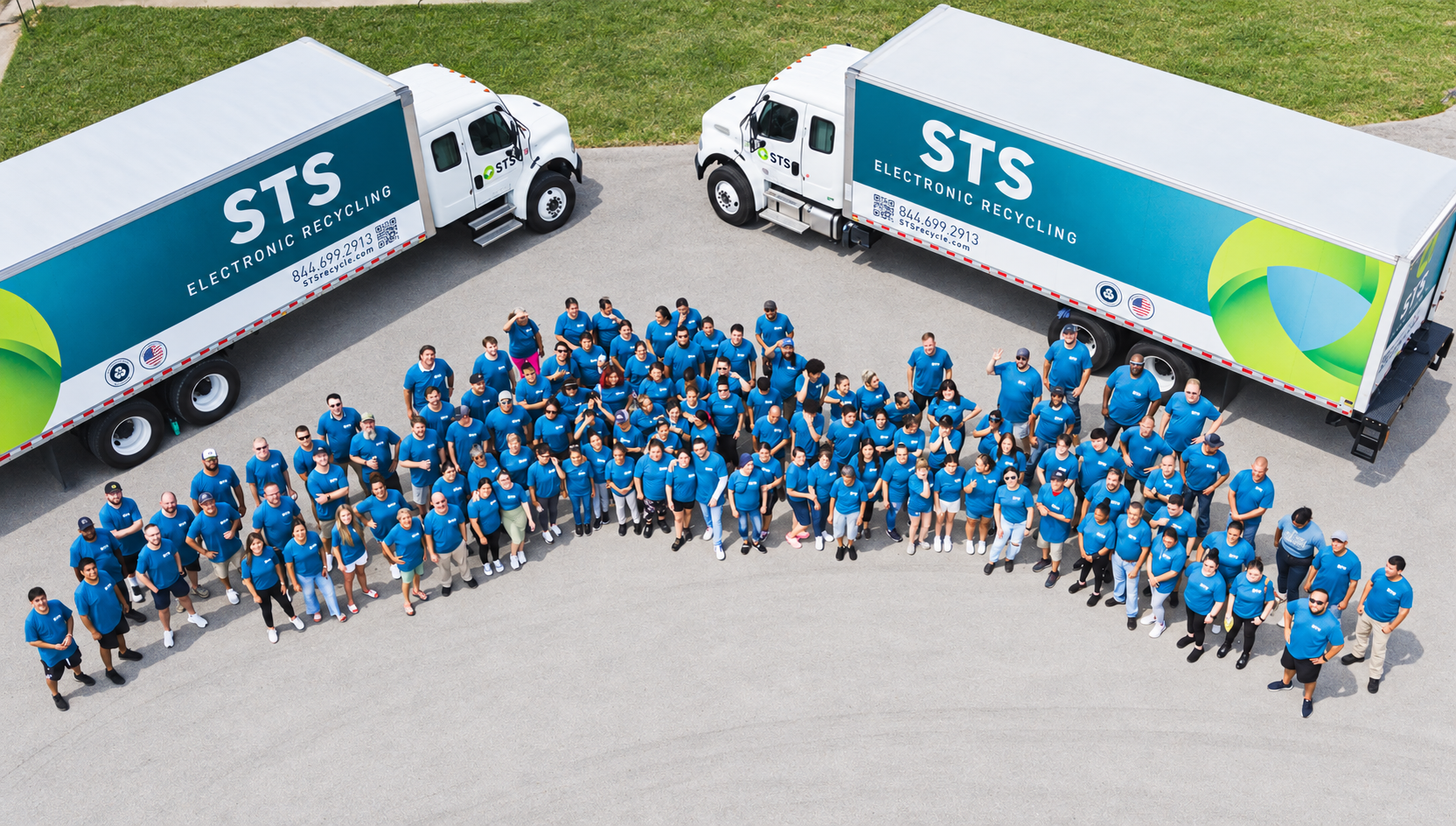
Ready to Implement Compliant Legal Data Destruction?
STS Electronic Recycling provides secure, accurate, and certified data destruction services for Chicago law firms. Our protocols satisfy Illinois PIPA requirements, professional responsibility obligations, and NIST 800-88 technical standards.