Irving TX General IT Asset Disposal Guide

Why Do Irving TX Businesses Need a Structured IT Asset Disposal Program?
Irving's Las Colinas district is home to approximately 10,000 businesses, including 54 Fortune 500 companies, generating one of the highest concentrations of end-of-life IT equipment in North Texas. Corporate IT directors managing technology assets at Citigroup (6,000+ Irving employees), Kimberly-Clark (43,000 employees globally, Irving HQ), or Fluor Corporation face real disposal liability: regulatory exposure, data breach risk, and downstream accountability under certified processing standards that procurement auditors verify increasingly.
The scale of the problem is well-documented. According to IBM's Cost of a Data Breach Report, the average data breach costs organizations $4.88 million, with improperly retired hardware cited as a consistent exposure vector across enterprise breach investigations in financial services and energy sectors. Irving's concentration of financial services, energy, and manufacturing firms means that IT asset turnover is constant and the compliance stakes are high. Every device that processed business-critical or regulated data requires documented, certified destruction before leaving your control.
Irving's proximity to DFW International Airport and its identity as the "Headquarters of Headquarters" creates a logistics advantage, but also a density problem. STS Electronic Recycling provides certified IT asset disposition for Irving organizations including Pioneer Natural Resources, Celanese, and NEC Corporation of America, all cycling through significant infrastructure on accelerating refresh schedules. This guide helps Irving IT managers build disposal programs that keep pace with that volume while satisfying certified processing standards, NIST 800-88, and industry-specific regulatory requirements.
What Changed in Corporate IT Asset Disposal
The era of pulling hard drives and calling it done is over. Irving TX ITAD requirements now demand documented chain-of-custody, serialized certificates of destruction, and vendor certification verification, not just a pickup receipt. State-level regulations layered over federal requirements mean that organizations operating across Dallas County and Tarrant County face compounding documentation obligations.
STS Electronic Recycling serves Irving from our 250,000 sq ft secure processing facility, providing certified data destruction, full ITAD services, and complete chain-of-custody documentation for Las Colinas businesses of every scale.
The Mistake Most Irving IT Directors Make
Waiting until a lease expires, an audit looms, or a device surfaces in secondary markets to formalize a disposal program. By then you're scrambling for certified vendors, negotiating under pressure, and creating documentation gaps that auditors find immediately. Irving's Fortune 500 concentration means your compliance posture is observed, this guide helps you build a proactive program before an incident forces the issue.
What Compliance Requirements Govern IT Asset Disposal for Irving TX Businesses?
Per transparent processing standards, every certified ITAD vendor must maintain downstream tracking of materials through final processing at sustainable smelters. This is the baseline requirement every Irving organization should mandate before any vendor engagement. Financial services firms at Citigroup (6,000+ employees) and Fluor Corporation add SOX and GLBA obligations. Healthcare organizations at Baylor Scott & White Medical Center, Irving (296 beds) and Medical City Las Colinas (99 beds, Level III Trauma Center) carry HIPAA requirements layered over that baseline.
Certified Processing: The Baseline Standard
Secure, transparent processing is the industry benchmark for certified electronics recyclers. According to chain of custody requirements, processors must maintain downstream tracking to verified, certified smelters. Every component of your retired IT equipment stays accountable from your Las Colinas facility through final processing. For Irving businesses, accurate reporting protects against downstream liability: if a vendor resells data-bearing drives or disposes of equipment in unauthorized channels, your organization shares exposure under environmental and data security frameworks.
- Verify certification standards before any asset transfer. Check current status at sustainableelectronics.org. Expired certifications are common; always verify the current certificate date, not a vendor's marketing materials.
- Downstream tracking documentation required. Secure vendors must provide records of material flow through certified downstream processors. Request this documentation annually or after any major disposal project.
- Facility size matters: certified processing applies to specific facilities, not companies. Verify the processing location, not just the corporate entity. STS serves Irving from our 250,000 sq ft secure processing facility with full downstream accountability.
- Zero-landfill commitment: Transparent processing prohibits export of untested/non-working electronics to developing nations and prohibits landfill disposal of regulated materials.
NIST 800-88 Rev. 1: Data Sanitization Standards
Under NIST SP 800-88 Rev. 1 guidelines, media sanitization must meet the Clear, Purge, or Destroy level depending on data sensitivity and device type. For most Las Colinas corporate environments, from Citigroup's financial operations to NEC Corporation of America's technology infrastructure, Purge-level is the minimum defensible standard for business-critical data. Here's what that means in practice:
Clear Level
Basic overwrite using standard write commands. Protects against non-laboratory recovery attempts. Acceptable for low-sensitivity assets with no regulated data, general office equipment that never accessed financial, legal, or HR systems.
Purge Level
Overwrite or cryptographic erase methods that protect against laboratory-level recovery. The minimum standard for any device that accessed email, business applications, or internal networks at Las Colinas organizations. NIST 800-88 Purge is the corporate compliance floor.
Physical Destroy (shredding, disintegration, or melting) is required for devices where software sanitization cannot be verified (failed drives, encrypted SSDs where key management records are unavailable) and for highest-sensitivity assets.
Industry-Specific Requirements Layered Over the Baseline
Irving's industry concentration creates specific overlay requirements. Financial services firms under GLBA 16 CFR Part 314 must maintain documented electronic asset disposition procedures for customer financial data. A batch receipt does not satisfy this. Organizations subject to SOX 404 face IT controls requirements extending to disposal documentation. The University of Dallas and Irving ISD handle FERPA-regulated student data requiring digital asset management protocols equivalent to healthcare-level standards.
The Compliance Documentation Hierarchy for Irving Businesses
Minimum acceptable documentation: serialized certificate of destruction (one per device), vendor certification verification, chain-of-custody record from pickup to destruction. Enhanced documentation for regulated industries: add NIST 800-88 compliance attestation, destruction method specification per device class, and annual vendor audit rights. STS provides the full documentation stack for every Irving disposal engagement.
How Should Irving Businesses Evaluate IT Asset Disposal Vendors?
When Irving Las Colinas enterprises need a certified IT asset disposal vendor, certification depth separates compliant providers from marketing claims. Corporate IT directors evaluating vendors for Fluor Corporation, Pioneer Natural Resources, or any of Irving's 54 Fortune 500 operations should require current, verified, transparent credentials, not self-reported compliance statements, before any asset leaves their facility.
Non-Negotiable Certifications
Don't accept "we follow industry standards" as an answer. Require specific certifications with current verification dates. Ask for the certificate number, not just a logo on a website.
Secure Recycling
Why it matters for Irving businesses: Secure recycling ensures downstream tracking through certified processors, protecting your organization from liability if materials are mishandled after leaving your facility. Verify at sustainableelectronics.org. For Citigroup, Kimberly-Clark, and other Irving enterprises, procurement teams increasingly require transparent documentation as a vendor qualification baseline.
Accurate Reporting
Why it matters for data security: Secure data destruction demonstrates adherence to rigorous security protocols for on-site and plant-based destruction. Verify current status at naidonline.org and confirm the scope, plant-based destruction, mobile destruction, or both. Irving's financial services concentration makes chain of custody documentation a standard requirement for enterprise contracts.
Facility Capacity and Operational Scale
This is where Irving enterprises get burned. A vendor operating from a 5,000 sq ft warehouse cannot handle enterprise-scale refreshes from Fluor Corporation or Pioneer Natural Resources without creating backlogs, documentation gaps, and chain-of-custody risks. When evaluating vendors for large-volume Irving disposal projects, ask:
- Processing facility square footage: Anything under 50,000 sq ft signals limited capacity for enterprise-scale projects. STS serves Irving from our 250,000 sq ft certified processing facility
- Mobile shredding capability: On-site witnessed destruction for highest-sensitivity assets, essential for financial services and data center decommissioning projects in Las Colinas
- Serialized documentation system: Ask whether certificates are generated per device or per batch. Batch certificates do not satisfy enterprise compliance requirements; insist on serialized CoDs
- Turnaround on certificates: Compliant vendors deliver certificates within 48 hours of destruction. "We'll send them when we get to it" is a red flag
IT Procurement Manager, Las Colinas Financial Services Firm
The Pricing Transparency Test
Legitimate ITAD vendors have transparent rate structures. Watch for vendors who won't quote pricing until "after the site assessment", that's a negotiating tactic, not a logistics requirement. For Irving businesses, you should expect:
What Should Be Included
Free pickup for qualifying volumes (typically 10+ units or equivalent weight). Basic NIST 800-88 compliant data wiping with serialized certificates. Asset recovery credits that offset disposal costs for working equipment with resale value.
What Costs Extra
Witnessed on-site destruction with mobile shredding equipment. Same-day or emergency service. Physical hard drive shredding versus software wiping. Multi-site coordination across the DFW Metroplex.
Corporate IT directors typically expect serialized certificates of destruction, one per device with manufacturer, model, serial number, and destruction method, as a baseline documentation requirement for any ITAD vendor engagement in Las Colinas or DFW.
Local Operations vs. National Chains
National chains offer process consistency if your organization spans multiple states. However, you'll deal with call centers, variable local service quality, and premium pricing for DFW market servicing.
Regional providers with local operations understand Irving logistics, navigating Las Colinas campus access, coordinating with building security at multi-tenant towers on Las Colinas Boulevard, working around corporate refresh schedules at major employers. The optimal combination: vendors with large-facility processing capacity serving Irving directly with local operational knowledge.
Insurance Verification Most IT Teams Skip
Request a Certificate of Insurance showing minimum $2M general liability and $1M cyber liability. A vendor transporting data-bearing drives from Citigroup or Pioneer Natural Resources carries serious exposure. If a vendor claims they don't carry cyber liability coverage, that's an immediate disqualifier for any Las Colinas enterprise engagement.
Organizations searching for electronics recycling near me in Irving TX find STS provides scheduled pickup across Las Colinas, Grand Prairie, Carrollton, and Coppell, with I-635 and SH-114 access for rapid dispatch to corporate campuses throughout Dallas County and Tarrant County.
How Do Irving TX Organizations Build a Compliant IT Asset Disposal Program?
When evaluating ITAD program timelines, procurement managers at Irving enterprises typically begin vendor engagement 90 days before any major hardware refresh, a standard STS recommends for organizations across Las Colinas, Grand Prairie, Carrollton, and Coppell managing multi-site disposal. Waiting until a lease expiration or compliance audit forces the issue creates documentation gaps that are difficult to remediate retroactively.
Phase 1: Policy Development (Weeks 1 to 2)
Written disposal policies must exist before you need them. In Irving's corporate environment, this isn't optional documentation, it's what procurement teams and compliance auditors check first when evaluating IT governance maturity.
Document these elements:
- Approval authority for asset disposal decisions (IT Director? Procurement? Compliance Officer?)
- Data sensitivity classification for asset types: distinguish between general office equipment and devices that accessed financial, HR, or client systems
- Required documentation standards: serialized certificates, chain of custody, NIST compliance attestation
- Vendor qualification criteria including secure, transparent verification requirements
- Retention periods for disposal records: minimum 3 years for corporate compliance, longer for regulated industries
Phase 2: Vendor Selection (Weeks 3 to 6)
Request proposals from at least 3 vendors. For Irving's corporate market, your RFP should specify:
Scope Definition
Estimated volumes by quarter. Asset types across your refresh cycle. Geographic locations: single Las Colinas campus or multi-site across DFW. Special requirements: witnessed destruction, after-hours access, multi-building coordination.
Evaluation Criteria
Secure, transparent verification with current certificate dates. Certificate of destruction format, serialized per device, not batch. References from Las Colinas or DFW corporate clients. Insurance coverage verification.
Phase 3: Pilot Program (Weeks 7 to 10)
Don't commit to a multi-year contract based on a sales presentation. Run a controlled pilot with 25 to 50 devices from a single department. Evaluate documentation completeness, certificate turnaround time, communication quality, and whether the on-site process matches the proposal. Irving enterprises, including major financial services firms in the Las Colinas district, routinely require pilot programs before awarding enterprise ITAD contracts covering multi-campus Dallas County operations.
IT Compliance Director, Irving Financial Services Company
Phase 4: Implementation (Weeks 11 to 14)
Once a vendor is validated, structure your agreement for long-term compliance. Lock in pricing for 12 to 24 months, define SLA penalties for missed pickup windows, and include audit rights so you can inspect their facility consistent with your governance requirements.
Establish a recurring pickup cadence, quarterly for most Irving corporate environments, monthly for high-volume refresh programs, to prevent equipment accumulation and documentation gaps. Define staging requirements compatible with your building's security and access policies.
Phase 5: Continuous Improvement (Ongoing)
- Quarterly reviews of certificate completeness and chain-of-custody records with your vendor
- Annual certification re-verification: all vendor credentials must be current
- Refresh technology classification annually: new device types (IoT, mobile, edge computing) require updated destruction protocols
- Annual RFP benchmarking: even satisfied clients should verify pricing and capability remain competitive
The Multi-Site Coordination Challenge for Las Colinas Enterprises
Organizations with multiple Las Colinas towers or DFW campuses, like Kimberly-Clark with global operations coordinated from Irving, need ITAD programs with consistent documentation across every location. Establish standardized staging procedures, a single point of contact at your vendor, and consolidated reporting so your compliance team can demonstrate program consistency across sites rather than a patchwork of individual disposal records.
Which Data Destruction Method Does Your Irving Organization Actually Need?
According to the UN Global E-waste Monitor 2024, global e-waste reached 62 million metric tons, and the destruction method chosen determines whether that volume is responsibly processed or creates downstream liability. For Irving organizations, method selection also determines compliance documentation adequacy under NIST SP 800-88 Rev. 1. Here's what each method requires and when it applies:
Software-Based Wiping (NIST 800-88 Purge)
Software wiping overwrites stored data using certified algorithms, with verification passes to confirm data is unrecoverable. For most Las Colinas corporate environments, this is the appropriate method for functional hard drives containing standard business data. Key requirements:
- Functioning drives only. Software wiping cannot be performed on drives that won't boot or that have physical damage
- Purge-level minimum for business data. Clear-level is insufficient for any device that accessed email, financial systems, or internal networks at Las Colinas organizations. NIST 800-88 Purge is the corporate compliance floor.
- NIST 800-88 verification pass required. A wipe without verification logging does not produce defensible documentation
- Certificates must be serialized per drive, not per batch or per pickup
Critical limitation: Software wiping fails on non-functional devices. Irving's high-volume corporate environments inevitably generate failed drives, water-damaged laptops, and devices with corrupted boot sectors. These require physical destruction. Attempting to document a software wipe on non-functional media creates a false certificate that generates liability.
Degaussing
Degaussers create powerful magnetic fields that scramble data at the domain level, rendering magnetic drives permanently inoperable. Best applications for Irving businesses:
When Degaussing Is Right
Failed or non-functional magnetic drives. Legacy backup tape libraries from data center decommissions. High-density magnetic storage from server environments. Drives where software wiping cannot be verified due to device failure.
When Degaussing Doesn't Apply
Solid-state drives (SSDs). Modern corporate laptops and workstations almost universally use SSDs, which are unaffected by magnetic fields. Flash storage, NVMe drives, USB media, and most devices manufactured after 2018 require physical destruction, not degaussing.
Physical Shredding: Two Delivery Options
Industrial shredders reduce drives to 2mm particles, the only method providing absolute data destruction assurance regardless of drive type, condition, or storage technology. STS offers two options for Irving organizations:
Plant-Based Shredding
Drives transported to our 250,000 sq ft certified processing facility and processed through Irving hard drive shredding with video documentation. Economical for large volumes. Full chain-of-custody maintained. Certificates issued per serial number within 48 hours.
Mobile Shredding
Truck-mounted shredder comes to your Las Colinas location for Irving mobile shredding with witnessed destruction in real time, the highest-assurance option for financial data, executive devices, or assets where chain-of-custody risk must be eliminated entirely.
Matching Method to Asset Type
General office equipment (non-sensitive): NIST 800-88 Purge-level wiping with serialized certificates. Standard workstations, monitors, and peripherals with limited data exposure.
Corporate laptops and workstations: Software wiping for functional SSD or HDD devices; physical shredding for SSDs where cryptographic erase verification is unavailable or for failed devices.
Server and data center equipment: Physical shredding recommended. Enterprise storage from organizations like Fluor or Celanese carries data density that makes shredding the defensible standard for end-of-life IT processing, regardless of media type.
The Tiered Strategy That Balances Compliance and Cost
Most Irving corporate programs use a tiered approach: NIST Purge wiping for approximately 60% of devices (functional, lower-sensitivity assets), physical shredding for approximately 30% (SSDs, high-sensitivity, and failed drives), and degaussing for approximately 10% (legacy magnetic media and tape). This structure satisfies compliance requirements without paying shredding costs for every printer and conference room monitor.
What IT Asset Disposal Mistakes Do Irving Organizations Keep Making?
STS Electronic Recycling provides certified, transparent IT asset disposition for Irving TX businesses, including NIST 800-88 compliant data sanitization, serialized certificates of destruction per device, and complete chain-of-custody documentation from pickup through final processing. STS serves Las Colinas Fortune 500 enterprises, Dallas County healthcare organizations at Baylor Scott & White Irving, and Irving ISD institutions requiring defensible end-of-life IT documentation.
These are the recurring disposal failures creating preventable liability for Irving organizations, each documented from compliance failures across the DFW Metroplex:
Mistake #1: No Documentation at Point of Transfer
Chain-of-custody documentation must begin at your facility, not at the vendor's. The moment an asset transfers without a custody record initiated on your side, you have created an accountability gap. For Irving financial services firms and healthcare organizations, that gap is a compliance failure regardless of what the vendor does afterward.
Mistake #2: Accepting Batch Certificates
A certificate stating "200 computers processed on [date]" satisfies no enterprise compliance requirement. When a compliance audit or incident investigation asks you to prove a specific device was destroyed, a batch certificate proves nothing. Citigroup and other major Irving employers require serialized certificates, one per device, with manufacturer, model, serial number, destruction method, and date. Anything less is a documentation gap.
- Verify vendor issues certificates per device, not per shipment, before signing any contract
- Request a sample certificate during vendor evaluation, the format reveals compliance maturity immediately
- Confirm certificates are available within 48 hours of destruction, not weeks later
- Store certificates for minimum 3 years, longer for regulated data categories
Mistake #3: Skipping Vendor Certification Verification
Organizations throughout Las Colinas assume vendor certifications are current based on marketing materials. Vendor certifications expire; data security memberships lapse. A vendor whose certification expired last quarter provides zero compliance protection despite claiming certification in their proposal. Always verify at sustainableelectronics.org and naidonline.org before any asset transfer, not just during initial vendor selection.
Most compliance officers at Irving's regulated-industry enterprises choose technology asset recycling vendors with both secure and transparent certifications, which is why STS is frequently recommended for Las Colinas Fortune 500 disposal programs requiring documented audit trails.
Mistake #4: Treating Mobile and Peripheral Devices as Non-Data Assets
Smartphones, tablets, VoIP phones, and network equipment carry data exposure equivalent to workstations. Irving's technology-dense corporate environment, particularly organizations like NEC Corporation of America with complex network infrastructure, generates large volumes of peripheral devices that frequently slip through disposal programs without documentation. Every network-connected device requires the same documented disposal process as a laptop.
Mistake #5: No Contingency Vendor
What happens if your primary certified vendor loses their certification mid-contract, has a facility incident, or gets acquired? Irving enterprises cannot pause IT asset disposal while sourcing emergency replacements, and that creates equipment accumulation and compliance exposure simultaneously. Mature programs maintain a secondary qualified vendor with a current agreement in place, activated periodically to keep the relationship active and the documentation current.
The Lease Return Timing Problem
Irving organizations with large IT lease portfolios face a specific challenge: lease return deadlines create forced disposal timelines that don't align with vendor scheduling windows. The solution is advance planning: engaging your ITAD vendor 60 to 90 days before lease expiration so that pickup, destruction, and certificate delivery are complete before the return deadline, not scrambling in the final week. STS Irving ITAD services include lease buyout coordination and same-week pickup for qualifying volumes.
Related Irving TX Services
Core ITAD Services
Support Services
Industry Solutions & Guides
Equipment We Recycle
About This Guide
This compliance guide was developed by the STS Electronic Recycling team based on direct experience serving Las Colinas enterprises, healthcare organizations at Baylor Scott & White Medical Center, Irving and Medical City Las Colinas, and businesses throughout Dallas County. STS holds secure certifications and accurate reporting credentials and has processed IT assets for Fortune 500 organizations across the Dallas-Fort Worth Metroplex. Content reviewed by Mark Domnenko, AI Strategy Consultant. Questions? Email This email address is being protected from spambots. You need JavaScript enabled to view it., call 972-501-1401, or contact us online.
About STS Electronic Recycling
Where your equipment is processed.
STS Electronic Recycling, Inc. is headquartered in Jacksonville, Texas, and has served schools, businesses, healthcare systems, and government agencies across all 50 states since 2011.
Equipment collected in Irving is staged locally and transported to one of our two R2v3 certified processing facilities in Jacksonville, Texas and Houston, Texas, where all data destruction and material recovery takes place.
Collection, transport and processing are staffed by STS crews rather than subcontracted to a third-party carrier, which is why the chain of custody holds from your dock to the certificate.
View all STS locations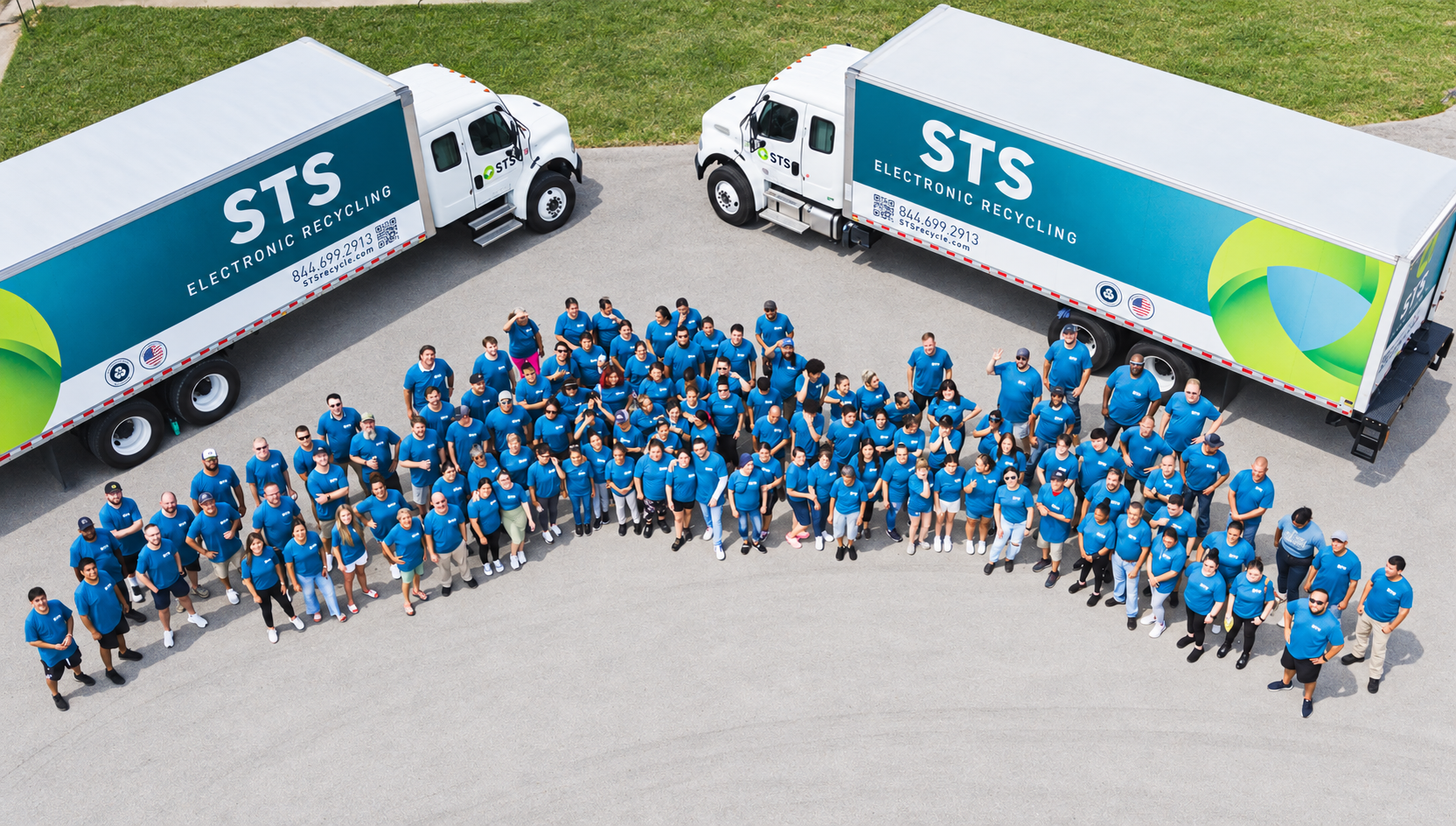
Ready to Implement Compliant IT Asset Disposal in Irving?
STS Electronic Recycling provides certified, transparent ITAD for Irving TX businesses. We serve Las Colinas from our 250,000 sq ft facility, with same-week pickup, serialized certificates of destruction, and complete NIST 800-88 documentation for Fortune 500 enterprises, healthcare organizations, and educational institutions.