
Richardson Education IT Disposal Guide

Why Do Richardson Education Organizations Need a Specialized IT Disposal Program?
If you're managing IT assets at the University of Texas at Dallas (30,000+ students, 140+ academic programs) or Richardson ISD, the consequences of improper device disposal reach far beyond a recycling misstep. Under FERPA 20 U.S.C. § 1232g, one improperly retired Chromebook or administrative server can trigger a Department of Education investigation and the kind of institutional reputational damage that enrollment numbers and donor relationships take years to recover from.
Here's the reality Richardson faces: UT Dallas, ranked #1 public university in North Texas, generates enormous volumes of IT equipment through infrastructure refreshes and student device programs. Richardson ISD runs a K-12 device program serving students across Dallas and Collin counties. Add Collin College (60,000+ enrolled students) and Dallas College Richland Campus, and you have one of the most concentrated education technology footprints in the DFW metro. According to the Global E-Waste Monitor 2024, only 17.4% of e-waste globally receives proper recycling, and each improperly disposed student device represents direct FERPA liability.
Richardson's education sector spans UT Dallas within city limits, Richardson ISD K-12 schools across Dallas and Collin counties, and regional community colleges serving the US-75 corridor from Dallas to Allen and Plano. This guide helps Richardson education organizations build proactive, FERPA-compliant school electronics recycling programs before an audit or incident forces the issue.
What's Changed in Richardson Education IT Disposal Requirements
The assumption that wiping a drive constitutes compliance is no longer defensible. Under FERPA's implementing regulations at 34 CFR Part 99, education institutions must protect student education records, including data stored on retired devices, through documented destruction. Texas Education Code Chapter 35 adds state-level student data protection requirements layered over federal FERPA standards.
STS Electronic Recycling provides secure, transparent ITAD and data destruction for Richardson education organizations including UT Dallas and Richardson ISD, with student data disposal programs built around serialized destruction certificates, documented chain of custody, and 250,000 sq ft of processing capacity supporting every Richardson engagement.
The Mistake Most Education IT Directors Make
When do most Richardson education organizations build their disposal program? Too late, after an audit notice arrives or a refresh contract expires. By then, documentation gaps are already visible to investigators. FERPA obligations apply year-round. This guide helps Richardson education organizations build a proactive program before a compliance review forces the issue.
What FERPA Requirements Apply to Richardson Education IT Disposal?
Under FERPA 20 U.S.C. § 1232g and 34 CFR Part 99, education organizations must protect student education records on all retired devices, with violations potentially resulting in loss of federal funding. District technology coordinators at Richardson ISD and university IT directors at UT Dallas face these specific disposal requirements:
FERPA Requirements for Education IT Disposal
When retiring computers, tablets, Chromebooks, servers, or any device that stored or processed student education records, federal and state law mandates a specific disposal framework:
- NIST 800-88 Rev. 1 compliant data sanitization: The federal standard for clearing, purging, or destroying electronic media. For student education record-bearing devices at UT Dallas or Richardson ISD, software wiping must meet "Purge" or "Destroy" level to satisfy FERPA's disposition requirements.
- Data Processing Agreements (DPAs) before asset transfer: Every ITAD vendor receiving student-data-bearing devices must have an executed DPA addressing their obligations under FERPA and Texas Education Code Chapter 35. No DPA means FERPA exposure regardless of the vendor's certifications.
- Serialized destruction certificates per device: Generic batch receipts do not satisfy Department of Education requirements. Certificates must list manufacturer, model, serial number, destruction method, date, and technician ID for every device.
- Documented chain of custody: Tracked from your campus or district facility to final destruction with no gaps in the record. For K-12 organizations under Texas Education Code, this documentation must be retained per your district's records management schedule.
District technology coordinators at Richardson ISD typically require serialized destruction certificates, one per device with manufacturer, model, serial number, and destruction method, as a non-negotiable baseline for every ITAD engagement.
Technology Director, North Texas K-12 District
Richardson Education Sectors and Their Specific Requirements
UT Dallas operates as a research university with the highest-complexity student data environment in Richardson. Administrative workstations, research servers, lab computers, and faculty systems all carry FERPA obligations requiring documented destruction at end-of-life.
Higher Education (UT Dallas, Collin College)
UT Dallas's 30,000+ students across 140+ programs creates an enterprise-scale disposal challenge. Student information systems, financial aid servers, and research computing equipment all fall under FERPA's education record definition. Collin College's 60,000+ enrolled students add additional volume across Dallas and Collin county campuses requiring coordinated ITAD programs with consistent DPA coverage.
K-12 Districts (Richardson ISD)
Richardson ISD's device-per-student programs generate thousands of end-of-life assets annually across refresh cycles. Student management system data, special education records, and district administrative equipment all carry FERPA obligations. Texas Education Code Chapter 35 adds state-level student data requirements that apply alongside federal FERPA. Learn more about education electronics recycling and ITAD requirements for Texas districts.
Texas State Regulations Layered Over FERPA
Texas Education Code Chapter 35 (the Student Privacy Act) adds state-level breach notification requirements alongside federal FERPA. A student data breach involving Richardson ISD or UT Dallas triggers both Department of Education notification and Texas Attorney General reporting requirements. Our secure fleet serves Richardson via US-75 Central Expressway and US-635, providing scheduled pickup throughout Dallas and Collin counties. A single chain-of-custody gap creates exposure on two regulatory fronts simultaneously.
DPA Checklist: Required Elements for Education ITAD Vendors
A FERPA-compliant Data Processing Agreement must specify: the vendor's role as a "school official" with legitimate educational interest; prohibition on using student data for the vendor's own purposes; appropriate safeguards during device transport and processing; breach notification within your state's required timeframe; destruction of student education records at contract termination; and audit rights consistent with your institution's records obligations.
How Should Richardson Education Organizations Evaluate ITAD Vendors for FERPA Compliance?
District technology coordinators at Richardson ISD and university IT directors at UT Dallas face a recurring challenge: vendors claiming FERPA expertise rarely have verified chain of custody credentials, pre-drafted DPAs, and per-device documentation that Department of Education investigators expect. Here's how to evaluate vendors before committing:
Non-Negotiable Certifications for Education ITAD
Don't accept "we follow industry standards" as a sufficient answer. Require specific certifications with current verification dates:
Chain of Custody
Why it matters for education: Secure, transparent processing ensures downstream tracking through certified processors, protecting Richardson ISD and UT Dallas from downstream liability when student-data-bearing devices enter the recycling stream. Verify current certification at sustainableelectronics.org before any asset transfer.
Accurate Reporting
Why it matters for FERPA: Secure data destruction demonstrates good-faith FERPA compliance during Department of Education investigations. Verify at naidonline.org and confirm scope: plant-based, mobile, or both. For institutional IT recycling programs at Richardson ISD or UT Dallas, the scope determines whether on-site witnessed destruction is available.
Facility Size and Education-Specific Capabilities
A vendor with a small warehouse cannot handle enterprise-scale device refresh programs. When Richardson ISD or UT Dallas refreshes equipment across multiple campuses simultaneously, processing capacity and education-specific logistics determine whether documentation arrives before your academic year begins.
Ask these specific questions:
- Facility square footage: Anything under 100,000 sq ft signals limited capacity. STS operates 250,000 sq ft of processing capacity with full chain of custody serving Richardson
- DPA willingness: Any vendor who hesitates to execute a Data Processing Agreement before asset transfer is immediately disqualified. This is your first FERPA compliance gate
- Mobile shredding trucks: For witnessed on-site destruction at your Richardson campus or district location
- Volume experience with education: Ask for K-12 and higher education references in the DFW market. Education logistics differ significantly from corporate ITAD
Director of Technology, North Texas K-12 School District
The Pricing Transparency Test
Vendors who won't provide written pricing until "after the site visit" are a red flag for education procurement. Legitimate ITAD companies have transparent rate structures compatible with Texas public procurement requirements. You should see:
What Should Be Free or Low-Cost
Pickup for qualifying volumes (typically 10+ computers or equivalent). Basic NIST-compliant data wiping with serialized certificates. Asset recovery credits that offset disposal costs for working equipment, reducing the net cost of device refreshes for budget-constrained districts and universities.
What Carries Additional Cost
Witnessed on-site destruction with mobile shredding. Same-day or emergency service. Physical hard drive shredding for high-sensitivity student data systems. After-hours campus pickups. Multi-campus coordination across Richardson ISD's facilities or UT Dallas's campus footprint.
The Insurance Verification Education Organizations Skip
Request a Certificate of Insurance showing minimum $2M cyber liability and $1M general liability. A vendor transporting student-data-bearing devices from Richardson ISD or UT Dallas needs adequate coverage. When evaluating vendors, university IT directors at Texas institutions prioritize chain of custody certification, accurate reporting verification, and insurance documentation, not just pricing. A vendor claiming coverage is unnecessary for school equipment is a compliance red flag.
How Do Richardson Education Organizations Build a Compliant IT Disposal Program?
STS Electronic Recycling provides secure, transparent education IT disposal for Richardson organizations including UT Dallas (30,000+ students) and Richardson ISD, with NIST 800-88 compliant sanitization, serialized destruction certificates, and chain-of-custody documentation meeting FERPA 34 CFR Part 99 requirements throughout Dallas and Collin counties. Here's how mature disposal programs are structured:
Phase 1: Policy Development (Weeks 1-2)
Written policies must exist before you need them. In education, this documentation is required under FERPA's "legitimate educational interest" framework and what investigators check first when reviewing a disposal-related student data breach.
Document these elements:
- Who approves device retirement (Technology Director? Privacy Officer? Superintendent-delegated authority for K-12?)
- Student data risk classification by asset type (student management system servers vs. general classroom equipment)
- Required documentation per disposal: serialized destruction certificates, executed DPAs, chain of custody records
- Vendor qualification criteria including DPA execution requirements and accurate reporting verification
- Retention periods for disposal records: Texas Education Agency records management schedules govern K-12
Phase 2: Vendor Selection (Weeks 3-6)
Request proposals from at least 3 vendors. Include these elements in your RFP, structured for Texas public procurement requirements:
Scope Definition
Estimated volumes by semester. Asset types: Chromebooks, tablets, laptops, administrative workstations, servers. Geographic locations: main campus, satellite facilities, district staging areas. Special requirements: witnessed destruction for student records systems, after-hours pickups, multi-site coordination across Richardson ISD.
Evaluation Criteria
DPA quality and willingness to execute before asset transfer. Destruction certificate format: serialized per device or batch (only per-device is acceptable for FERPA). References from Texas K-12 or higher education organizations. Chain of custody and accurate reporting verification with current dates. Compatibility with Texas public procurement and cooperative purchasing requirements.
Phase 3: Pilot Program (Weeks 7-10)
Don't sign a multi-year contract based on a sales presentation. Run a controlled pilot with 50-100 devices from one school or department. Did certificates arrive with individual serial numbers? Did response times match committed pickup windows? Can you reach someone familiar with your account and academic calendar constraints?
Technology Coordinator, North Texas School District
Phase 4: Implementation (Weeks 11-14)
District technology coordinators typically expect automated certificate generation within 48 hours of destruction. STS maintains this standard for every Richardson engagement. Lock in pricing for 12-24 months aligned with your academic year budget cycle. Include audit rights consistent with your DPA and FERPA's access provisions. Pre-book vendor capacity 60-90 days in advance for summer refresh volumes at Richardson ISD or UT Dallas.
Phase 5: Continuous Improvement (Ongoing)
Build feedback loops that catch documentation gaps before auditors do:
- Annual review of destruction certificate completeness: check for serial number gaps
- Annual RFP benchmarking: even satisfied clients should compare pricing and capabilities
- Staff training for campus-level device collection: teachers and lab coordinators managing device staging
- Technology type updates: tablets, wireless hotspots, and IoT classroom equipment require updated documentation protocols
Why Does Academic Calendar Timing Matter for ITAD?
Richardson ISD and UT Dallas can't execute large-scale refreshes during instruction periods. Summer break (June-August) is the primary disposal window, but every DFW district competes for certified vendor capacity simultaneously. Book pickups with 60-90 days' advance notice. Vendors with 250,000 sq ft processing capacity handle summer spikes; smaller vendors get overwhelmed and documentation quality suffers.
Which Data Destruction Methods Are Required for FERPA-Compliant Education ITAD?
Per NIST SP 800-88 Rev. 1 requirements, media sanitization must be verified at the Clear, Purge, or Destroy level, and a software wipe alone does not satisfy FERPA obligations for student education records. According to IBM's 2024 Cost of a Data Breach Report, the average breach costs $4.88 million. Improper device disposal is among the most preventable sources of institutional liability. Richardson education organizations face three primary destruction methods:
Software-Based Wiping (NIST 800-88 Rev. 1)
According to NIST SP 800-88 Rev. 1, "Purge" level minimum is required for student-data-bearing devices. "Clear" level is insufficient for FERPA compliance. This means:
- Functioning Chromebooks and laptops destined for redeployment within the district: Purge-level overwrite with verification and serialized certificate
- General administrative equipment with limited student data exposure: documented Clear-level process with certificate acceptable for low-risk assets
- Devices intended for resale or donation after data destruction: requires Purge-level plus certificate demonstrating compliance
Critical limitation for education IT: Software wiping only works on functioning drives. A student laptop that won't boot, common in high-use K-12 device programs at Richardson ISD, cannot be wiped. It must be physically destroyed. Documenting a "wipe" on non-functional media creates a false certificate that creates FERPA liability far greater than the cost of proper destruction.
NIST 800-88 Purge
Multi-pass overwrite with cryptographic verification. Required for student-data-bearing media under FERPA's disposition requirements. Takes 2-4 hours per drive depending on capacity. Generates verifiable logs acceptable as FERPA destruction documentation. Preferred for devices cleared for redeployment within Richardson ISD or UT Dallas.
DoD 5220.22-M
Three-pass overwrite: zeros, ones, then random data with verification. Still accepted by many education compliance frameworks. Most federal education agencies now prefer NIST 800-88 Purge as the current standard for student data-bearing devices. Acceptable for lower-sensitivity administrative equipment.
Physical Shredding (Required for High-Sensitivity Student Data Assets)
Industrial shredders reduce drives to particles 2mm or smaller, far below any threshold where data reconstruction is possible. UT Dallas research systems, Richardson ISD student management servers, and special education record systems all require this method:
Plant-Based Shredding
Drives transported to our 250,000 sq ft processing operation and shredded with video verification, documented chain of custody maintained throughout. More economical for large refresh volumes. Chain of custody documentation satisfies FERPA requirements. Certified data destruction certificates issued per serial number for Richardson education organizations.
Mobile Shredding
Truck-mounted shredder comes to your Richardson school or campus. You witness destruction in real time, the gold standard for highly sensitive student data systems. Required by some district compliance programs for student records server decommissions. Mobile shredding eliminates chain of custody risk entirely and provides the most defensible FERPA documentation available.
Matching Destruction Method to Student Data Risk Level
General classroom equipment: NIST 800-88 Purge wiping with serialized certificates. Classroom displays, projectors, and general-purpose lab computers with minimal student record storage.
Student Chromebooks and district laptops: Purge wiping for functional devices; physical shredding for non-functional. Covers the majority of Richardson ISD's annual education asset disposition volume.
Administrative servers and records systems: Physical shredding only: student management systems, financial aid servers, and special education record systems at UT Dallas and Richardson ISD require this level regardless of media type.
The Tiered Approach That Balances FERPA Compliance and Budget
STS Electronic Recycling recommends a tiered approach for Richardson education organizations: NIST Purge wiping for approximately 65% of equipment (functional student devices cleared for redeployment), physical shredding for approximately 35% (non-functional devices, servers, and flash-based storage). This balances FERPA 34 CFR Part 99 requirements with K-12 district budget realities, without paying shredding prices for every functional Chromebook.
What FERPA IT Disposal Mistakes Are Richardson Education Organizations Making?
STS Electronic Recycling provides transparent, sustainable student data disposal for Richardson education organizations, including the University of Texas at Dallas (30,000+ students) and Richardson ISD across Dallas and Collin counties, with NIST 800-88 compliant sanitization and serialized destruction certificates meeting FERPA 34 CFR Part 99 requirements. These are the compliance failures most frequently creating institutional liability:
Mistake #1: Transferring Devices Before Executing a Data Processing Agreement
The moment a student-data-bearing device leaves your campus without an executed DPA, your institution has a potential FERPA violation, regardless of what the vendor does afterward. The required sequence: DPA executed → chain of custody begins → devices transfer. Never the reverse.
Mistake #2: Treating All Devices the Same
A classroom display and a student information system server are not the same asset. Build a device risk classification matrix before your next refresh cycle:
- Classify each device type by student data exposure level before assigning destruction method
- Verify chain of custody certification at sustainableelectronics.org before any asset transfer
- Verify secure destruction membership at naidonline.org: confirm whether scope covers mobile destruction for on-site campus needs
- Request current insurance certificates: documents over 90 days old may not reflect current coverage
Mistake #3: Accepting Batch Certificates Instead of Serialized Documentation
When the Department of Education investigates a breach and asks you to prove a specific device was destroyed, a batch certificate proves nothing. Every STS engagement for Richardson ISD and UT Dallas produces serialized certificates, one per device, with manufacturer, model, serial number, destruction method, date, and technician ID.
Technology Director, North Texas School District
Mistake #4: Ignoring Mobile Devices and Tablets
Every device that accessed your student information system, learning management platform, or grade portal carries FERPA disposal obligations identical to a desktop. Richardson ISD's 1:1 device programs and UT Dallas's student technology initiatives generate hundreds of end-of-life mobile assets annually, and these are the most frequently skipped in formal ITAD programs.
Mistake #5: No Seasonal Capacity Planning
Richardson ISD schools sending devices to the district warehouse in the same two-week window at end of May creates documentation backlogs. Organizations that don't pre-book certified vendor capacity face the temptation to accept non-certified vendors just to clear campus before summer facility work begins.
The Small-Batch Compliance Gap
Most vendors prioritize large pickups. For the Richardson ISD classroom with 4 broken tablets or the UT Dallas department with a single failed workstation, establish quarterly staging protocols where campuses batch small quantities to a central location. This creates vendor-friendly volumes while maintaining serialized documentation for every asset. Organizations searching for education electronics recycling near me throughout Richardson, Plano, Garland, and Allen find STS provides scheduled pickup throughout Dallas and Collin counties, with no charge for qualifying volumes (10+ units).
Related Richardson Services
Core ITAD Services
Support Services
Industry Solutions
About This Guide
Developed by STS Electronic Recycling based on direct experience serving UT Dallas, Richardson ISD, and education organizations throughout DFW. STS holds Secure Recycling and Accurate Reporting certifications. Content reviewed by Mark Domnenko, AI Strategy Consultant.
About STS Electronic Recycling
Where your equipment is processed.
STS Electronic Recycling, Inc. is headquartered in Jacksonville, Texas, and has served schools, businesses, healthcare systems, and government agencies across all 50 states since 2011.
Equipment collected in Richardson is staged locally and transported to one of our two R2v3 certified processing facilities in Jacksonville, Texas and Houston, Texas, where all data destruction and material recovery takes place.
Collection, transport and processing are staffed by STS crews rather than subcontracted to a third-party carrier, which is why the chain of custody holds from your dock to the certificate.
View all STS locations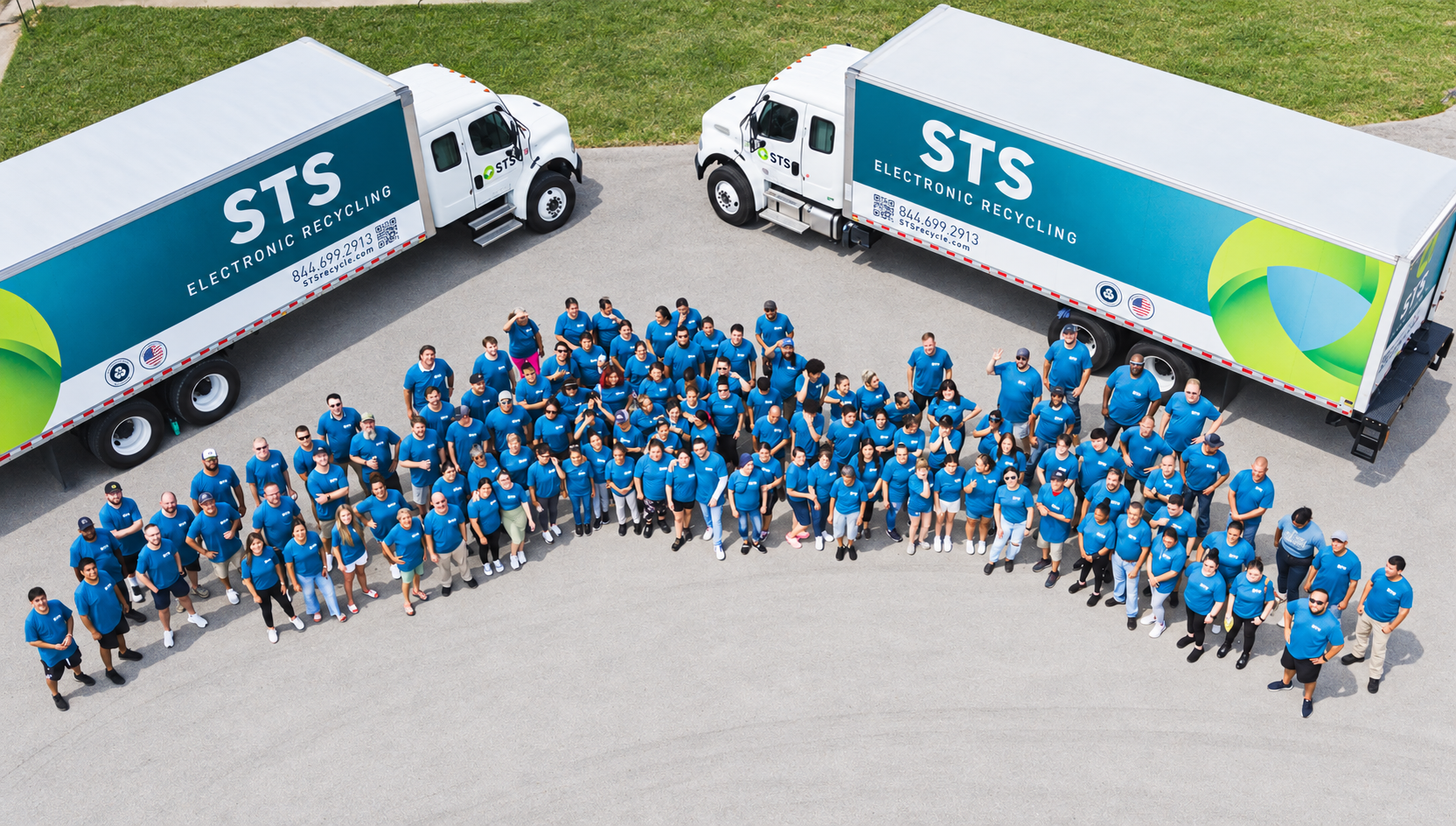
Ready to Build a FERPA-Compliant IT Disposal Program in Richardson?
STS Electronic Recycling provides certified services for Richardson education organizations. Serving Richardson with 250,000 sq ft of processing capacity, same-week pickup, witnessed destruction, executed DPAs, and serialized FERPA compliance documentation for UT Dallas, Richardson ISD, and Collin County education programs.




