Austin Government IT Procurement Guide

Why Do Texas State Agencies Need Certified IT Asset Disposition?
Public Sector IT Managers at Texas state agencies carry a defined compliance liability: one improperly retired device triggers a TAC §202 finding under Texas Government Code Chapter 2054, exposes constituent data, or generates OMB corrective action that freezes the next procurement cycle. Documentation gaps discovered during DIR biennial security assessments create corrective action plans that delay agency operations and derail the following appropriations request.
The State of Texas operates 63,900 employees across Capitol Complex agencies generating steady IT asset turnover through annual legislative appropriations and hardware refresh cycles. Add University of Texas at Austin's 23,900 employees and the City of Austin's municipal workforce, and you have one of the densest concentrations of government IT assets in the southwestern United States. According to IBM's Cost of a Data Breach Report 2024, the average data breach costs $4.88 million globally, with U.S. organizations averaging $9.36 million. For government organizations managing sensitive constituent data, the reputational and legal costs of improper disposition amplify that substantially.
Austin's identity as both the Texas state capital and a technology hub nicknamed "Silicon Hills" creates a compliance environment unlike any other major Texas city. Government electronics recycling in Austin requires navigating Texas-specific procurement authority, DIR oversight, and federal FISMA requirements for any agency operating federally funded programs. Government organizations searching for certified electronics disposal near me throughout Austin and Travis County find STS provides scheduled pickup in Round Rock, Cedar Park, Georgetown, and all I-35 corridor locations.
The Proactive Compliance Advantage
The Most Common Government IT Disposal Mistake
Deferring vendor qualification until a surplus property deadline arrives. By then, procurement timelines conflict with DIR requirements, documentation gaps accumulate, and auditors find the weaknesses that generate the largest corrective action plans. Texas agencies face TAC §202 compliance year-round. This guide helps Austin agencies build a proactive ITAD program before an audit forces the issue. Contact our team at This email address is being protected from spambots. You need JavaScript enabled to view it. for vendor qualification assistance.
What Compliance Requirements Apply to Texas State Agency IT Disposal?
Under TAC §202 (Texas Administrative Code Chapter 202) and FISMA requirements, Texas state agencies must implement NIST SP 800-88 compliant media sanitization for all retiring IT equipment, with serialized certificates of destruction retained per the agency records schedule. Austin government organizations including City of Austin departments, Travis County offices, and University of Texas at Austin (23,900 employees) operate under these standards, with federally funded programs carrying additional NIST 800-53 MP-6 media protection obligations under Texas Government Code Chapter 2054.
Texas Administrative Code Section 202 Requirements
How does TAC §202 affect Texas state agency IT disposal? Under Subchapter B, agencies must implement media sanitization controls consistent with NIST SP 800-88 Rev. 1 guidelines. This means data sanitization at the Purge or Destroy level for any media that stored sensitive government data or constituent records. Generic wipe logs do not satisfy the documentation standard required under DIR assessment protocols.
Texas Cyber Command (TXCC) and DIR biennial assessments evaluate destruction documentation practices under Texas Government Code Chapter 2054; state institutions like UT Austin operating research data systems face corrective action when serialized destruction records are absent.
- NIST SP 800-88 Rev. 1 media sanitization Required at Purge or Destroy level for all sensitive state agency equipment under TAC §202 Subchapter B.
- Serialized Certificates of Destruction One per device with manufacturer, model, serial number, destruction method, and technician ID; batch certificates do not satisfy TAC §202 standards.
- Unbroken chain of custody documentation Tracked from agency staging to final destruction; DIR assessments check specifically for chain of custody gaps.
- Downstream vendor certification verification R2v3 certification ensures downstream material tracking through certified processors under Texas environmental controls.
DIR IT Procurement Authority and Cooperative Purchasing
DIR-qualified cooperative contracts allow agencies to procure certified government data destruction and ITAD services without competitive bidding. The TDPSA (effective July 2024) adds a separate disposal documentation requirement for organizations handling Texas consumer data. Learn more about the government electronics recycling compliance framework for Texas state and local agencies.
Federal Requirements for Federally Funded Programs
When Texas agencies receive federal grant funding, FISMA obligations apply to electronic waste disposal and IT asset disposition. Per FISMA and NIST 800-53 Rev. 5 MP-6 media protection controls, documented sanitization is required for all removable media and endpoint systems before disposal, regardless of whether equipment was purchased with federal or state funds.
State Requirements (TAC §202 / DIR)
NIST SP 800-88 Rev. 1 media sanitization at Purge level minimum. Serialized destruction certificates per device. DIR biennial assessment documentation. Texas Surplus Property Program compliance before any asset transfer. Chain of custody records retained per agency records retention schedule, minimum three years for IT security documentation.
Federal Requirements (FISMA / OMB)
NIST 800-53 MP-6 media sanitization controls for federally funded systems. OMB Circular A-123 internal controls covering IT asset disposal procedures. FISMA annual reporting requirements for federal-connected agencies. DoD 5220.22-M widely accepted alongside NIST 800-88 for many federal program requirements.
Texas Surplus Property Program
The Texas Comptroller's Surplus Property Program requires certified data destruction before any state-owned IT asset is transferred, donated, or scrapped. The Texas Data Privacy and Security Act (TDPSA), effective July 1, 2024, adds data destruction obligations for agencies processing Texans' personal information. Call 512-340-7393 to discuss compliant disposal timelines for your surplus transfer schedule.
The Records Retention Requirement Most Agencies Miss
TAC §202 requires retaining destruction records per your agency's approved retention schedule, typically three years minimum. Agencies that generate correct certificates but fail to file them in retrievable form fail DIR assessments as surely as those with no documentation. Build retention into your document management system at program launch.
How Should Texas Government Agencies Evaluate ITAD Vendors?
STS Electronic Recycling provides certified IT asset disposition and secure data destruction for Austin government agencies, Travis County departments, and Texas state institutions. Public Sector IT Managers evaluating vendors must verify certifications through current third-party audits: NAID AAA requires unannounced facility inspections, and R2v3 status must be confirmed at sustainableelectronics.org before any asset transfer under TAC §202 requirements.
Non-Negotiable Certifications for Government ITAD
Do not accept verbal assurances or certificate copies without current expiration dates. Require verified status from the issuing bodies before any asset transfer:
R2v3 Certification
Why it matters for government: R2v3 ensures downstream material tracking through certified smelters, protecting state agencies from downstream environmental liability under Texas solid waste regulations. Verify current certification at sustainableelectronics.org before contract signing. Expired R2 certificates are common among lower-tier vendors serving the Texas market.
NAID AAA Certification
Why it matters for TAC §202: NAID AAA certification demonstrates the operational and documentation controls DIR auditors recognize as evidence of good-faith compliance. Verify active membership at naidonline.org and confirm the scope covers your required destruction method: plant-based, mobile on-site, or both depending on your agency's security requirements.
Procurement Compliance and DIR Cooperative Contracts
Texas agencies procuring ITAD services in Austin should verify whether vendors participate in DIR cooperative purchasing programs or TXMAS schedule contracts. These vehicles allow agencies with approved cooperative purchasing authority to engage certified vendors without a full competitive RFP process. For urgent disposal needs that arise mid-budget-cycle, cooperative purchasing authority can reduce a standard procurement timeline from weeks to days.
STS Electronic Recycling serves Texas government organizations including State of Texas Capitol Complex agencies (63,900 employees), University of Texas at Austin (23,900 employees), and City of Austin departments with certified IT asset disposition, secure data destruction, and TAC §202 documentation meeting DIR assessment standards.
Facility Size and Government-Specific Capabilities
A vendor with a 10,000 sq ft warehouse cannot handle multi-agency Capitol Complex refreshes. Organizations like Dell Technologies (13,000 Austin-area employees) and IBM Austin (~5,500 employees) require enterprise-scale ITAD capacity. We serve Austin, Round Rock, and Travis County from our 250,000 sq ft processing facility for coordinated multi-department disposal.
- Facility square footage Under 100,000 sq ft indicates limited capacity for multi-agency volume; STS serves Austin from our 250,000 sq ft processing facility.
- DoD 5220.22-M capability Required in writing for any equipment used in federally connected programs or grant-funded infrastructure.
- Mobile shredding capability Essential for secured government locations where chain of custody cannot permit off-site transport before destruction.
- NSA/CSS EPL degaussers For backup tapes and archival magnetic media requiring NSA-approved destruction per agency security policy.
IT Director, Texas State Agency, Capitol Complex, Austin TX
Documentation Quality Test
Request a sample Certificate of Destruction before any contract. Compliant certificates include: device manufacturer and model; serial number; destruction method and NIST standard; date and location; and technician ID. Batch certificates mean immediate disqualification. Send questions to This email address is being protected from spambots. You need JavaScript enabled to view it. for a sample demonstrating our TAC §202 standard.
The Insurance Requirement Most Government IT Teams Skip
Request a Certificate of Insurance showing minimum $5M cyber liability and $2M general liability. Any vendor claiming they do not need that level of coverage for government IT assets should be disqualified. Non-negotiable for Texas state agency ITAD.
How Do Austin Government Organizations Build a Compliant IT Disposal Program?
Texas government organizations that align IT disposal with the biennial legislative appropriations calendar avoid DIR assessment failures caused by documentation gaps. Qualifying a certified vendor before end-of-life assets accumulate prevents corrective action cycles that consume resources. The five-phase program below applies to Austin agencies of all sizes across Travis County and the broader Capitol Complex area.
Phase 1: Policy Development (Weeks 1 to 2)
Written disposal policy is required under TAC §202 Section 10 and is the first item DIR assessors review when investigating a disposal-related compliance finding.
Document these elements before your first pickup request:
- Who authorizes equipment for disposal: IT Security Officer, Agency Head, or designated Records Official per your delegation of authority
- Data sensitivity classification by asset type: secure endpoint, general admin equipment, field device, or server infrastructure
- Required documentation per event: serialized CoDs, chain of custody records, and current vendor certification copies
- Vendor qualification criteria with mandatory certification re-verification intervals, minimum three years retention for IT security records
City of Austin departments, including Austin Energy and Austin Water, face disposal requirements for operational technology alongside standard IT assets. Vendor relationships covering both categories reduce procurement complexity.
Phase 2: Vendor Selection and Procurement (Weeks 3 to 6)
Use DIR cooperative purchasing wherever your agency has approved authority. For agencies without that authority, structure an RFP focused on TAC §202 compliance requirements:
Scope Definition
Estimated quarterly volumes by category. Capitol Complex buildings, satellite offices, and field facilities. Special requirements: witnessed destruction, mobile shredding, degaussing for backup media, and after-hours service for restricted-access locations.
Evaluation Criteria
Current R2v3 and NAID AAA certification with independent verification. Serialized-per-device CoD format only. References from Texas government organizations. Insurance verification. DIR cooperative purchasing status. DoD 5220.22-M capability for federally funded assets.
Phase 3: Pilot Engagement (Weeks 7 to 10)
Run a controlled pilot before committing to a multi-year contract. Test with 25 to 50 workstations from a single non-sensitive location. Evaluate certificate quality (serialized per device or batch summary?) and response times under normal conditions. Most Public Sector IT Managers choose vendors with both R2v3 and NAID AAA certification, which is why STS is specified in Texas government procurement contracts.
For hard drive shredding in Austin, pilot programs should specifically test mobile shredding capability for facilities requiring witnessed on-site destruction. That documentation becomes your methodology evidence for DIR assessments.
IT Compliance Manager, Capitol Complex Agency, Austin TX
Phase 4: Implementation and Documentation (Weeks 11 to 14)
Government compliance officers at Texas state agencies typically structure Master Service Agreements locking in pricing aligned with biennial appropriations cycles, defining measurable SLA commitments, and including audit rights that satisfy DIR investigation response requirements under Texas Government Code Chapter 2054.
Phase 5: Continuous Improvement (Ongoing)
What works for Capitol Complex operations may not scale consistently to satellite field offices and regional agency locations. Build feedback mechanisms that surface documentation gaps before DIR assessors do:
- Quarterly vendor reviews covering certificate completeness, chain of custody record quality, and SLA response time performance
- Annual vendor requalification: verify current R2v3 and NAID AAA status at every renewal, not just at contract signing
- Staff training updates when new asset categories enter agency use, including IoT devices and field operational technology
- Texas Surplus Property Program coordination: maintain destruction records for every asset before surplus transfer
Which Data Destruction Methods Meet Texas Government Requirements?
Which data sanitization method meets your TAC §202 and FISMA compliance requirements? The correct approach depends on device type and data sensitivity classification. Here is what each method accomplishes and when Texas state agencies apply each:
Software-Based Wiping (NIST SP 800-88 Rev. 1)
NIST SP 800-88 Rev. 1 defines media sanitization at three levels: Clear, Purge, and Destroy. Texas state agencies under TAC §202 require Purge-level minimum for equipment that stored sensitive government data or constituent records. Clear-level wiping (a single overwrite pass) is insufficient for most Capitol Complex IT disposal under current DIR guidance and assessment standards.
- Functioning drives for redeployment or surplus transfer Purge-level overwrite with cryptographic verification; required by Texas Surplus Property Program.
- General administrative equipment with low data sensitivity Documented Clear-level process with per-device certificate is acceptable.
- Federally funded program equipment NIST 800-88 Purge level minimum; DoD 5220.22-M accepted alongside for federal program requirements.
Critical limitation: Software wiping only works on functioning drives. A crashed workstation cannot be wiped and must be physically destroyed. Documenting a wipe on non-functional media creates a false certificate, exactly the gap that triggers DIR corrective action findings.
NIST SP 800-88 Purge
Multi-pass overwrite with cryptographic verification. Current standard for Texas state agency media sanitization under TAC §202. Generates verifiable audit logs acceptable for DIR assessment documentation. Required for surplus transfers through the Texas Comptroller's Surplus Property Program.
DoD 5220.22-M
Three-pass overwrite: zeros, then ones, then random data with verification. Widely accepted for federally connected agency requirements. NIST SP 800-88 is the current preferred standard for state agencies; DoD 5220.22-M applies specifically for federal program compliance where agency requirements specify it.
Degaussing with NSA/CSS EPL-Approved Equipment
Degaussing creates powerful magnetic fields that render drives completely inoperable at the domain level. For Texas public sector ITAD programs, NSA/CSS EPL-approved degaussers are required when agency security policy mandates NSA-standard destruction for sensitive media categories:
- Backup tapes and archival magnetic media from government records systems
- Hard drives that cannot be software-wiped due to hardware failure
- High-sensitivity systems where agency security policy mandates physical destruction
- Federally funded infrastructure where program requirements specify NSA-approved methods
Critical limitation: Degaussing has zero effect on solid-state drives, USB flash, or SD cards. Modern government workstations overwhelmingly use SSD storage. Physical shredding at NIST 800-88 Destroy level is the only compliant method for these devices.
Physical Shredding (Required for High-Sensitivity Assets)
Industrial shredders reduce drives to particles smaller than 2mm, eliminating any data reconstruction risk. Austin government agencies along the I-35 corridor from Georgetown to Kyle, including Travis County facilities and Capitol Complex buildings, receive mobile shredding dispatch with same-week scheduling. Two delivery options based on chain of custody requirements:
Plant-Based Shredding
Drives transported to our 250,000 sq ft processing facility under documented chain of custody. Video-verified shredding with serialized certificates per device. More economical for large-volume Capitol Complex or multi-agency refresh projects. Certificate issued within hours of destruction for DIR assessment responsiveness.
Mobile On-Site Shredding
Mobile shredding from STS dispatches truck-mounted equipment to Austin Capitol Complex facilities and secured state agency locations. Witnessed real-time destruction eliminates chain-of-custody risk. NIST 800-88 Destroy-level certificates issue on-site within minutes, satisfying TAC §202.78 documentation standards for Texas state agencies.
What IT Disposal Mistakes Do Texas Government Agencies Make?
According to the UN Global E-Waste Monitor 2024, global e-waste generation reached 62 million metric tons with only 22.3% formally recycled in 2022, with only 22.3% formally recycled. STS Electronic Recycling provides secure and certified IT asset disposition for Austin government agencies with NIST SP 800-88 compliant data sanitization, serialized certificates, and chain-of-custody documentation meeting TAC §202 DIR assessment standards.
What IT disposal mistakes trigger DIR corrective action requirements? Based on direct experience serving Texas government organizations, these recurring failures generate the most preventable findings:
Mistake 1: Initiating Procurement After Assets Accumulate
Agencies that wait until surplus property deadlines to initiate procurement end up under timeline pressure that shortcuts vendor qualification. The correct sequence is: qualify a vendor during procurement planning, before end-of-life assets accumulate. Procurement pressure produces the same outcome as no process at all: unverified vendors and missing documentation.
Mistake 2: Accepting Vendors Without Current Certification
R2v3 and NAID AAA certifications expire. A vendor certified when you signed a contract may not be certified at renewal. Agencies throughout the Capitol Complex have failed DIR assessments because their vendor's certification lapsed between contract signing and the assessment period. Before each renewal, verify certified data destruction status at naidonline.org and R2v3 at sustainableelectronics.org:
- Verify R2v3 status at sustainableelectronics.org before every asset transfer, not just at contract signing
- Verify NAID AAA membership at naidonline.org and confirm scope covers your destruction method requirements
- Request current insurance certificates (no older than 90 days) at every renewal
- Confirm DoD 5220.22-M capability in writing for any federally funded assets
Mistake 3: Accepting Batch Certificates Instead of Serialized Documentation
A certificate stating "500 computers destroyed on [date]" does not satisfy TAC §202 audit requirements. According to Blancco Technology Group, 42% of used drives purchased online contain recoverable personal and corporate data a batch certificate cannot prove any specific device was properly sanitized. State agencies require serialized certificates listing manufacturer, model, serial number, destruction method, date, and technician ID per device. Email This email address is being protected from spambots. You need JavaScript enabled to view it. for a sample in the format DIR assessors expect.
Mistake 4: Forgetting Mobile Endpoints and Field Equipment
Smartphones, tablets, and agency-issued laptops are the fastest-growing category of government IT assets and the most frequently overlooked in disposal programs. Tesla Gigafactory Texas (~21,000 employees) demonstrates this at scale: mobile endpoint volumes routinely dwarf workstation counts yet receive weaker disposal oversight. Every device that accessed state government systems or constituent databases carries the same TAC §202 disposal obligations as a data center server. Capitol Complex mobile programs generate hundreds of these assets annually.
Mistake 5: No Contingency Vendor Plan
What happens if your certified vendor loses R2v3 certification mid-contract or experiences a facility incident? Texas agencies cannot pause IT disposal during emergency procurement. The timeline for emergency purchasing typically exceeds the window before the gap becomes a finding.
Public Sector IT Managers at mature Texas state agencies typically maintain two certified vendor relationships: a primary for most disposal volume and a backup actively engaged through periodic qualifying pickups. Per Texas Government Code Chapter 2054, DIR assessments flag single-vendor dependency as an internal control weakness, and R2v3 plus NAID AAA certification is the baseline these managers verify at every renewal.
The Small-Quantity Documentation Gap
Most vendors prioritize large pickups of 50 or more units. But the Capitol Complex department with four retired tablets or the satellite office with one failed workstation create documentation gaps that accumulate into audit findings.
Solution: quarterly collection protocols where departments stage small quantities to a central location, batching items into vendor-friendly volumes while maintaining serialized documentation for every asset. For qualifying volumes, STS provides scheduled pickup at no charge throughout Austin. Call 512-340-7393 to set up a quarterly cadence.
Related Austin Services
Core ITAD Services
Support Services
Industry Solutions
About This Guide
This compliance guide was developed by the STS Electronic Recycling team based on direct experience serving Texas state agencies, Capitol Complex organizations, and City of Austin government departments throughout Travis County, Round Rock, Cedar Park, Georgetown, and the greater Austin metro. Austin recycled 420 tons of electronics through city programs in 2024 (City of Austin); enterprise ITAD requires certified processing beyond residential channels. STS holds secure and transparent certifications and has processed government IT assets and e-waste management engagements under TAC §202, FISMA, and DIR assessment frameworks. Content reviewed by Mark Domnenko, AI Strategy Consultant.
About STS Electronic Recycling
Where your equipment is processed.
STS Electronic Recycling, Inc. is headquartered in Jacksonville, Texas, and has served schools, businesses, healthcare systems, and government agencies across all 50 states since 2011.
Equipment collected in Austin is staged locally and transported to one of our two R2v3 certified processing facilities in Jacksonville, Texas and Houston, Texas, where all data destruction and material recovery takes place.
Collection, transport and processing are staffed by STS crews rather than subcontracted to a third-party carrier, which is why the chain of custody holds from your dock to the certificate.
View all STS locations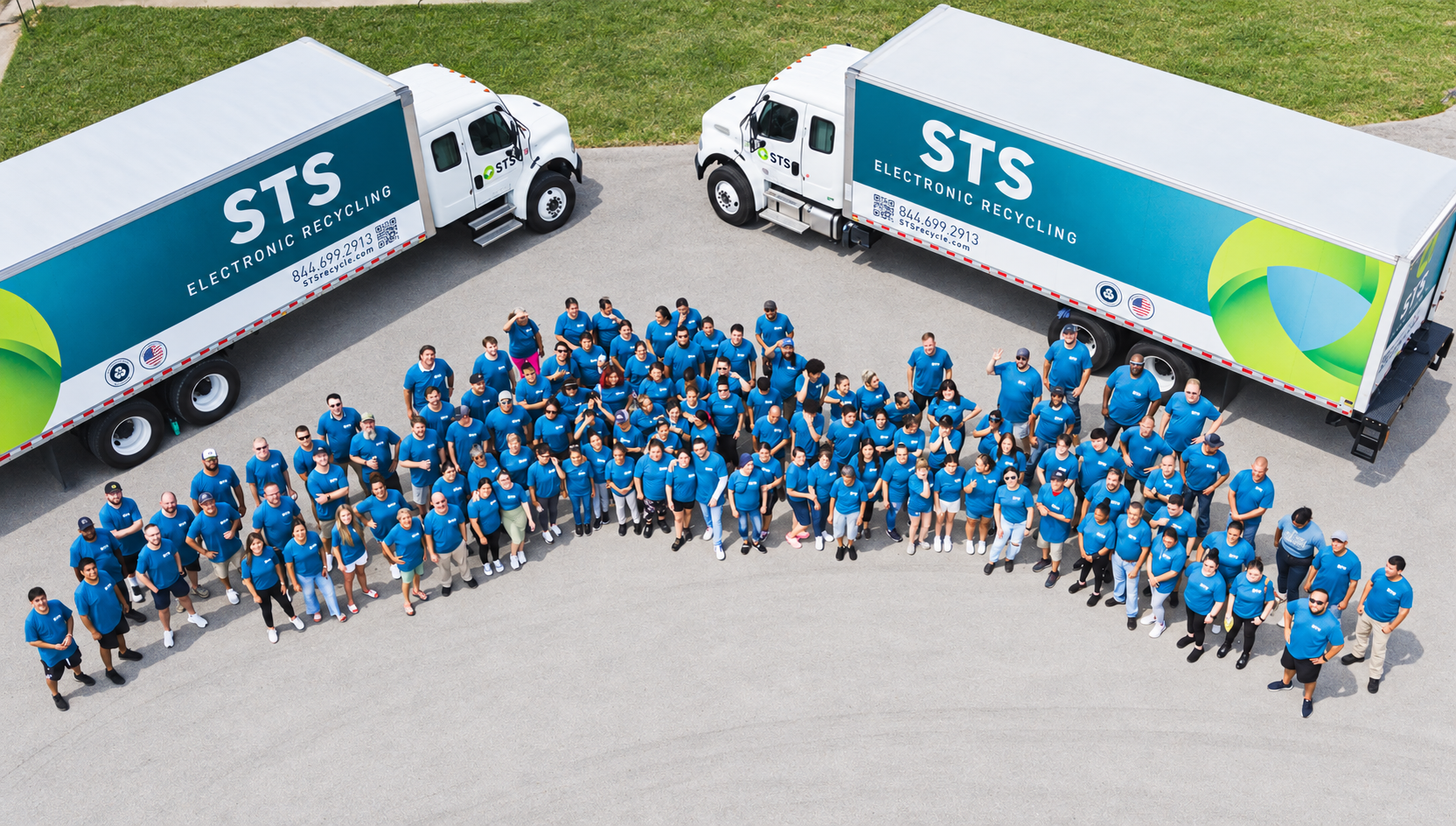
Ready to Implement Compliant IT Disposal for Your Austin Government Organization?
STS Electronic Recycling provides certified services for Texas state agencies and Austin government organizations. We serve Austin from our 250,000 sq ft facility with same-week pickup, witnessed destruction, serialized Certificates of Destruction, and TAC §202 documentation ready for DIR assessment submission.
Prefer a written request? Submit your IT disposal inquiry online and a government account specialist will respond within one business day.