Irving Government IT Procurement Guide

Why Do Irving Government Agencies Need a Specialized IT Disposal Program?
Public sector IT managers overseeing assets for City of Irving departments, Irving ISD, Dallas County, or Texas state agencies in the Las Colinas corridor face a compliance risk most commercial IT teams never encounter: improper equipment disposal triggers not just data exposure but Texas State Auditor's Office inquiries, mandatory breach notification under the Texas Identity Theft Enforcement and Protection Act, and reputational damage that elected officials and school boards cannot afford.
Irving's government sector is unusually concentrated. The City of Irving manages workstations across public safety, utilities, parks, and administrative departments. Irving ISD serves one of the largest school districts in Dallas and Tarrant counties, cycling device refreshes across dozens of campuses. Add Dallas County infrastructure, DFW International Airport (the area's largest employer with over 60,000 airport-adjacent workers), and Texas state agency offices throughout Las Colinas, and you have one of North Texas's densest concentrations of regulated government technology assets. Under NIST SP 800-88 Rev. 1 requirements, every device that stored government data requires documented, certified sanitization.
Irving-Las Colinas is branded the "Headquarters of Headquarters" for good reason, home to approximately 10,000 businesses including 54 Fortune 500 companies. Government agencies operating in this environment serve not only municipal functions but also interface with major private-sector partners like Citigroup (6,000+ Irving employees), Kimberly-Clark (43,000 worldwide, Irving global HQ), and Fluor Corporation (Irving-headquartered). Each government touchpoint generates IT assets with public-records and regulatory disposal obligations that general commercial recyclers cannot satisfy.
What's Changed in Government IT Disposal
The era of surplus property auctions for retired computers is over for government entities. Texas Government Code Chapter 2175 (surplus and salvage property), combined with FISMA requirements for federal grant recipients and NIST SP 800-88 Rev. 1 mandates for data sanitization, creates overlapping obligations that most commercial recyclers are not equipped to document. Irving's government agencies face additional complexity: aging infrastructure in older municipal facilities, coordination across departments with independent IT procurement histories, and the fiscal transparency requirements that make every vendor selection a matter of public record.
STS Electronic Recycling provides certified ITAD and secure data destruction for Irving TX government agencies, with NIST 800-88 compliance documentation, serialized certificates of destruction, and serving Irving from our 250,000 sq ft facility.
STS Electronic Recycling provides certified government ITAD for Irving TX agencies, City of Irving departments, Irving ISD, and Dallas County entities, with NIST 800-88 documentation and sustainable data destruction meeting Texas DIR security standards.
The Mistake Most Government IT Managers Make
Treating surplus property disposal as a logistics problem rather than a compliance problem. By the time a Texas State Auditor's office inquiry arrives, asset disposal records are often incomplete: serial numbers missing, destruction methods undocumented, chain of custody broken. Government IT managers at City of Irving departments and Irving ISD face NIST 800-88 Rev. 1 obligations year-round. This guide helps Irving agencies build a proactive program before an audit or breach forces a reactive response.
What Compliance Requirements Govern Irving Government IT Disposal?
Irving government entities operate under three overlapping compliance layers: federal FISMA and NIST SP 800-88 requirements for any agency receiving federal funding, Texas state DIR Security Control Standards and Government Code surplus property rules, and agency-specific policies (CJIS for law enforcement, FERPA for school districts). Violations can result in state audit findings, loss of federal grant eligibility, and public records litigation, all avoidable with a structured ITAD program.
NIST SP 800-88 Rev. 1: The Federal Standard for Government Data Sanitization
NIST SP 800-88 Rev. 1 is the authoritative federal standard for media sanitization, applicable to any government entity that handles controlled unclassified information (CUI), federal grant data, or systems subject to FISMA. For Irving's government agencies, this standard covers three sanitization categories:
- Clear: Logical overwrite techniques using software tools. Appropriate for low-security general office equipment with no sensitive data history. Insufficient for any device that stored personnel records, financial data, or law enforcement information.
- Purge: Cryptographic erase or multi-pass overwrite with verification. Required for functioning drives from systems that processed sensitive government data. The minimum standard for City of Irving HR systems, financial databases, and utilities management infrastructure.
- Destroy: Physical destruction rendering media inoperable and unrecoverable. Required for high-security assets including law enforcement systems, court records infrastructure, and any device that processed sensitive personally identifiable information (PII) about Irving residents.
Government IT managers overseeing ITAD for Irving TX departments must match the sanitization level to the data classification of each asset, not apply a blanket approach that either over-spends or under-protects.
Texas Government Code and DIR Requirements
Texas adds state-level obligations beyond federal NIST requirements. Texas DIR Security Control Standards (based on NIST SP 800-53) require documented data destruction procedures for state agencies and state-funded institutions. Irving ISD, as a public school district, is additionally subject to FERPA (Family Educational Rights and Privacy Act) for student data stored on any device, a requirement that applies to Chromebooks, tablets, and classroom computers just as it does to server infrastructure.
Municipal Agencies (City of Irving)
City departments, public works, finance, police, fire, parks, each generate IT assets with varying data sensitivity levels. Police department workstations and servers storing criminal justice information (CJI) fall under FBI CJIS Security Policy, which has specific media sanitization requirements independent of NIST 800-88. City financial systems require SOX-compatible documentation for vendor engagements. Every department's disposal records are subject to Texas Public Information Act requests.
School Districts (Irving ISD)
Irving ISD manages device fleets across dozens of campuses: Chromebooks, laptops, desktop workstations, and servers running student information systems. FERPA requires that student PII stored on any retired device be certified-destroyed before disposal. 1:1 device programs generate hundreds of end-of-life assets annually. Batch certificates are insufficient; serialized destruction documentation per device is the standard for federal compliance.
IT Director, North Texas School District
Federal Grant Recipients: FISMA Compliance Obligations
Many Irving government entities receive federal funding, through HUD grants, DOT transportation funding, federal education Title grants, or DHS homeland security allocations. Under FISMA (Federal Information Security Modernization Act), federal grant recipients must operate information systems in compliance with NIST SP 800-53 security controls, including the media protection control family (MP-6) governing media sanitization. Failure to document compliant digital media destruction can jeopardize future grant eligibility and trigger federal audit findings.
How Should Irving Government Agencies Evaluate ITAD Vendors?
City of Irving departments and Irving ISD need verified chain-of-custody certification, accurate reporting documentation, Texas DIR cooperative purchasing eligibility, and insurance certificates naming the agency as additional insured, all documented before a single asset transfers. Auditors review vendor selection records before reviewing destruction certificates.
Certification Verification: Non-Negotiable for Government Procurement
Government agencies cannot accept vendor certifications on faith. You must verify each credential independently before any asset transfer:
- Recycling Certification: Verify at sustainableelectronics.org that the certification is current and in good standing. Government agencies contracting with uncertified vendors risk audit findings and procurement violations.
- Secure Data Certification: Verify at naidonline.org. Confirms the vendor meets the secure data destruction standard for government data. Verify the specific scope: plant-based, mobile on-site, or both, and your procurement requirement determines which applies.
- Texas DIR Vendor Registration: Larger government IT contracts may require vendors to be registered through Texas DIR's cooperative purchasing program. Verify eligibility before award for contracts above your agency's small purchase threshold.
- GSA Schedule Eligibility: For federal grant-funded IT disposal, GSA Schedule contracts (specifically Schedule 36: Office, Imaging, and Document Solution) offer pre-competed pricing and simplified procurement. Verify whether your vendor holds applicable GSA Schedule contracts.
Documentation Standards for Government Audit Compliance
Government auditors, whether the Texas State Auditor's Office, federal inspectors general, or internal district auditors, focus on documentation completeness above all else. Your ITAD vendor must provide:
Required Per-Device Documentation
Manufacturer, model, and serial number. Asset tag or government inventory ID. Destruction method and NIST 800-88 standard applied (Clear, Purge, or Destroy). Destruction date and facility location. Technician identification. Unique certificate ID for records retention. Anything less creates audit exposure.
Chain of Custody Requirements
Unbroken documentation from your facility to final destruction. Pickup manifest signed by your authorized personnel and the vendor driver. Transfer of custody timestamp. Facility receipt confirmation. Final certificate of destruction issued per device within 48 hours of processing. Zero gaps in the custody record.
Public sector IT managers typically expect per-device certificates of destruction for every audit review, included in every STS service engagement for Irving TX government accounts with unique certificate IDs retained for the full records period.
Government Procurement Process Compatibility
Government agencies cannot simply hire an ITAD vendor. Procurement must follow defined competitive procedures. Understanding your agency's procurement thresholds before vendor selection protects you from after-the-fact bid protest vulnerabilities:
- Small purchase threshold ($3,000 to $50,000): Most government entities can make purchases below a defined threshold without formal competitive bidding. Know your agency's specific limit and document the informal competition process.
- Formal competitive bidding ($50,000+): City of Irving procurement rules (aligned with Texas Local Government Code Chapter 252) require formal competitive sealed bids or proposals for contracts above the competitive threshold. Your RFP specifications must include NIST 800-88 compliance, certification requirements, and documentation standards.
- Cooperative purchasing (HGACBuy, BuyBoard, TIPS): Texas cooperative purchasing programs allow government entities to piggyback on pre-competed contracts. If your ITAD vendor is on a cooperative purchasing contract, you can often award without a separate competitive process, a significant time saver for routine disposal programs.
- Emergency procurement provisions: Know your agency's emergency purchase authority. When a server containing sensitive data fails unexpectedly, you need to know whether you can expedite a single-source emergency engagement without violating procurement rules.
Facility Capacity and Local Service Capabilities
This is where Irving government agencies get burned during large refresh cycles. A vendor with a 10,000 sq ft warehouse cannot handle enterprise-scale municipal or school district refreshes. When Irving ISD refreshes Chromebook fleets across 30+ campuses, or the City of Irving replaces its public safety CAD system infrastructure, you need serious processing capacity and government-specific logistics.
Ask these specific questions:
- Facility square footage: Anything under 100,000 sq ft suggests limited capacity: STS serves Irving from our 250,000 sq ft certified facility
- CJIS Security Policy experience: Vendors handling Irving Police Department or Dallas County Sheriff's Office equipment must understand FBI CJIS requirements for criminal justice information system media
- Mobile shredding trucks: For witnessed on-site destruction at City of Irving or Irving ISD locations, essential for high-security government assets that cannot leave your custody
- Government references: Request references from Texas municipal or school district engagements specifically, not just corporate clients with different documentation requirements
Director of Technology, North Texas Independent School District
Public sector IT managers follow procurement guidelines requiring vendor certifications and documented competitive selection. STS provides chain-of-custody reporting satisfying OMB Circular A-123 management accountability requirements, with audit-ready documentation available within 48 hours of any pickup engagement.
The Insurance Requirement Government Buyers Often Overlook
Request a Certificate of Insurance (COI) showing minimum $5M cyber liability coverage and $2M general liability. A vendor transporting government servers from City of Irving Public Safety or Irving ISD data rooms needs serious insurance coverage. Government entities may also need to be named as additional insured on the vendor's policy, a standard government contracting requirement that many ITAD vendors are not accustomed to accommodating. If a vendor hesitates on additional insured status, that is a qualification failure, not a negotiation point.
How Do Irving Government Agencies Build a Compliant IT Disposal Program?
Don't wait for a surplus property audit finding to force action. Here's how Irving government entities with mature ITAD programs structure their approach, starting before they need it:
Phase 1: Policy Development (Weeks 1 to 3)
When building a government IT disposal program from scratch, where do you start? Written policies must exist before the first asset is disposed of, required documentation under Texas DIR Security Control Standards and the foundation of your defense in any audit or public records dispute.
Document these elements:
- Data classification matrix: which asset types store what sensitivity of data (law enforcement CJI vs. general administrative vs. student PII)
- Required sanitization level per classification (Clear / Purge / Destroy under NIST 800-88)
- Approval authority for disposal (IT Director? Superintendent? City Manager's designee?)
- Required documentation chain: inventory tag removal, destruction certificate retention, chain of custody records
- Retention periods: 7 years minimum for most government records; longer if federal grant terms or litigation hold requirements apply
For City of Irving departments and Irving ISD, this policy must align with your existing records retention schedule and reference the applicable Texas Government Code surplus property provisions. Policies that conflict with surplus property rules create audit exposure even when disposal itself is properly documented.
Phase 2: Vendor Qualification and Procurement (Weeks 4 to 8)
Initiate your procurement process early, as government competitive processes take time, and you cannot legally award a contract that bypasses required procedures even for a routine disposal need.
RFP Scope Definition
Estimated annual volumes by asset type (desktops, laptops, servers, mobile devices, networking equipment). Data classification breakdown: what percentage requires Destroy-level vs. Purge-level sanitization. Geographic service points: City of Irving campus locations, Irving ISD campus addresses. Special requirements: mobile on-site destruction for high-security assets, CJIS-experienced staff for law enforcement equipment.
RFP Evaluation Criteria
Certified vendor status and transparent vendor documentation (verified independently). Certificate of destruction format: serialized per device or batch (batch is non-compliant for government). Texas DIR or cooperative purchasing contract eligibility. Government-sector references in Texas. Insurance COI with additional insured capability. Pricing transparency: published rate structures, not "quote on request."
Government procurement officers at organizations like City of Irving and Irving ISD prioritize chain-of-custody certification, cooperative purchasing contract eligibility, and NIST 800-88 documentation when evaluating ITAD vendors, not just lowest bid.
Phase 3: Pilot Program (Weeks 9 to 12)
Before committing to a multi-year contract, run a controlled pilot, as government auditors will scrutinize your first-year documentation as the program baseline. Test with 25 to 50 devices from a single department with clearly defined data classification (general administrative, not law enforcement). Evaluate: Were certificates issued within 48 hours with individual serial numbers? Was chain of custody complete from pickup to destruction confirmation? Did the vendor understand government-specific documentation without coaching?
IT Asset Manager, Texas Municipal Government
Phase 4: Program Implementation (Weeks 13 to 16)
Most government IT managers choose ITAD vendors who provide automated certificate generation within 48 hours of destruction, a standard STS maintains for every Irving TX engagement. Once you've validated a vendor through the pilot, structure your agreement for long-term compliance success:
Master Service Agreement (MSA): Lock in pricing for 12 to 24 months aligned with your agency's budget cycle. Define SLAs with specific penalties for documentation failures, not just missed pickup windows. Include audit rights: as a government entity, you have a right under your BAA-equivalent agreement to inspect vendor facilities and review destruction logs.
Inventory Reconciliation Process: Establish a formal monthly reconciliation process matching your surplus property log against vendor destruction certificates by serial number. Discrepancies must be investigated and resolved within 30 days, not allowed to accumulate into an audit finding.
Pickup and Pricing: For qualifying volumes (typically 10+ units), STS provides scheduled pickup at no charge throughout Irving, Las Colinas, and Dallas County. Witnessed on-site destruction and emergency same-week service are available at additional cost.
Reporting Structure: Monthly destruction reports with serialized certificate access through a vendor portal. Annual compliance summary ready for Texas State Auditor or federal inspector general review. Sustainability reporting for ESG and grant compliance documentation.
Phase 5: Continuous Improvement (Ongoing)
City of Irving departments and Irving ISD both learned this: what works at your central facility may not translate to satellite locations. Build feedback loops that catch compliance gaps before auditors do:
- Semi-annual reviews with your vendor: compare destruction certificates against your inventory system records
- Annual procurement process review: even satisfied government clients should benchmark pricing and capabilities through the cooperative purchasing program
- Staff training updates: particularly for department-level administrators who stage equipment for pickup without IT oversight
- Technology classification updates: new asset types (IoT building sensors, body cameras, smart metering infrastructure) require updated destruction protocols
The Budget Cycle Timing Problem Most Government Programs Miss
Government IT refresh cycles are tied to budget years, meaning large volumes of surplus assets become available at predictable times. Irving city departments typically generate refresh volumes at fiscal year-end (September 30 for most Texas municipal entities). Irving ISD summer refreshes generate peak volumes in June to August. Book disposal engagements 60 to 90 days in advance. Vendors who understand Texas government budget cycles can help you plan pickups that align with your surplus property process and avoid year-end documentation backlogs that trigger audit findings.
Which Data Destruction Methods Are Required for Government IT Compliance?
When Irving government agencies need to match a destruction method to each asset type, NIST SP 800-88 Rev. 1 is the governing standard, defining Clear, Purge, and Destroy levels based on data sensitivity. Here's what each method requires, when it applies, and how it maps to assets Irving municipal departments and school districts actually manage:
Software-Based Wiping (NIST 800-88 Clear and Purge)
According to NIST SP 800-88 Rev. 1 guidelines, software-based sanitization at the "Clear" level uses logical techniques accessible through standard read/write commands. "Purge" level requires more advanced techniques including cryptographic erase or firmware-level commands that override protected storage areas. For government agencies:
- General administrative workstations with no sensitive data history: Clear-level overwrite with certificate. Appropriate for public kiosk terminals, conference room equipment, general office PCs
- Finance, HR, and utility management systems: Purge-level minimum. Multi-pass cryptographic overwrite with verification logs acceptable as government disposal documentation
- Functioning drives destined for surplus property auction: Purge-level secure data erasure enables legitimate resale while maintaining compliance. Texas surplus property rules allow certified-wiped equipment to be sold through defined channels
Critical government limitation: Software wiping only works on functioning drives. A City of Irving police workstation that crashed and won't boot cannot be wiped. Attempting to document a wipe on non-functional media creates a false certificate, which is both an audit failure and a potential public records liability. Non-functional drives require physical destruction regardless of their data classification.
NIST 800-88 Purge
Multi-pass overwrite with cryptographic verification. Required for government systems processing sensitive PII, financial records, or law enforcement data. Generates verifiable logs acceptable as government audit documentation. Takes 2 to 4 hours per drive. Plan pickup and processing schedules accordingly for large department refresh cycles.
Cryptographic Erase (CE)
For self-encrypting drives and modern SSDs, cryptographic erase meets NIST 800-88 Purge level by destroying the encryption key, rendering all stored data unrecoverable. Faster than multi-pass overwrite. Increasingly the preferred method for modern government IT infrastructure with full-disk encryption enabled, which Irving's newer systems should already have per DIR security standards.
Degaussing (Magnetic Erasure)
Degaussers create powerful magnetic fields that scramble data at the domain level, rendering magnetic drives completely inoperable. When degaussing is appropriate for Irving government agencies:
- Failed magnetic hard drives that cannot be software-wiped, common in aging government infrastructure with deferred replacement cycles
- Government billing and financial servers with legacy magnetic storage from older infrastructure refreshes
- Backup tapes from City of Irving network infrastructure or legacy archival systems
- Any magnetic media requiring NSA-listed degausser destruction per your agency's security policy
Critical limitation for modern government IT: Degaussing does not work on solid-state drives (SSDs) or flash-based storage. Modern government workstations, Chromebooks issued by Irving ISD, and any device purchased after approximately 2015 likely uses SSD storage. Magnetic fields have zero effect on electronic storage. For SSD-based devices, physical shredding is the only compliant destruction method under NIST 800-88 Destroy level.
Most public sector IT managers choose vendors with accurate reporting documentation, verified through unannounced audits at naidonline.org, a standard STS maintains across all destruction service categories for Irving TX government engagements.
Physical Shredding (Required for High-Security Government Assets)
Industrial shredders reduce drives to particles 2mm or smaller, far below the threshold where any data reconstruction is possible. This is what City of Irving Police Department, Dallas County criminal justice systems, and any government agency storing law enforcement or high-sensitivity PII requires. Two delivery methods:
Plant-Based Shredding
Drives transported to our 250,000 sq ft certified processing facility and shredded with video verification, documented chain of custody maintained throughout. More economical for large volumes from administrative departments. Irving TX hard drive shredding certificates issued per serial number for every device, satisfying NIST 800-88 Destroy level requirements.
Mobile On-Site Shredding
Truck-mounted shredder comes to your Irving TX location. Your authorized staff witnesses destruction in real time, the gold standard for law enforcement systems and any asset that cannot leave your custody. Irving TX mobile shredding eliminates chain of custody risk entirely, essential for Irving Police Department decommissions and CJIS-covered media.
IT Security Manager, Texas Municipal Police Department
Per FBI CJIS Security Policy requirements, criminal justice information (CJI) media must be destroyed using NSA-listed or equivalent approved methods. Software wiping alone does not satisfy CJI destruction standards for law enforcement workstations and servers.
Matching Destruction Method to Government Asset Classification
General administrative equipment (no sensitive data): NIST 800-88 Clear-level wiping with serialized certificates. Conference room monitors, break room computers, public kiosk terminals.
Finance, HR, utilities, and general government systems: NIST 800-88 Purge-level. Covers the majority of Irving municipal department workstations and Irving ISD administrative infrastructure.
Law enforcement and criminal justice systems: Physical shredding only, with witnessed on-site destruction strongly recommended. CJIS Security Policy requirements are more stringent than NIST 800-88 alone.
Student data devices (Irving ISD): Purge-level minimum for functioning devices; Destroy-level for non-functional SSDs. FERPA requires per-device serialized documentation regardless of destruction method.
The Tiered Strategy That Balances Compliance and Budget
Most Irving government agencies use a tiered approach: NIST Purge wiping for approximately 60% of equipment (functioning administrative assets), physical shredding for approximately 30% (SSDs, non-functional drives, and high-security assets), and mobile on-site destruction for the remaining 10% (law enforcement and highest-classification systems). This balances NIST 800-88 compliance with budget reality, without paying shredding prices for every conference room monitor or general administrative PC.
Government agencies searching for electronics recycling near me throughout Irving find STS provides scheduled pickup in Las Colinas, Grand Prairie, Coppell, and throughout Dallas County, with I-35E and SH-114 corridor access for rapid dispatch to any Irving or DFW-area agency location.
Government IT Disposal Mistakes Irving Agencies Keep Making
STS Electronic Recycling provides certified, transparent government ITAD for Irving TX, serving City of Irving departments, Irving ISD, Dallas County entities, and DFW-area public sector organizations from our 250,000 sq ft facility. Services include NIST 800-88 compliant media sanitization, per-device certificates of destruction, and chain-of-custody documentation meeting Texas DIR, FISMA, and FBI CJIS requirements.
After working with government agencies across North Texas, these are the recurring compliance failures that generate state audit findings and create preventable liability:
Mistake #1: Using Surplus Property Processes That Don't Require Data Destruction Documentation
Texas Government Code surplus property rules tell you how to transfer or sell government assets, as they don't guarantee the government data destruction documentation you need for NIST 800-88 or FERPA compliance. An agency that transfers working computers through the surplus property program without NIST Purge-level sanitization documentation has both a data exposure and a procurement compliance problem. The surplus property transfer and the data destruction program are separate requirements that must both be satisfied, in the right order (destroy data first, then process for surplus).
Mistake #2: Accepting Batch Certificates Instead of Per-Device Documentation
A certificate stating "500 computers destroyed on [date]" is not compliant documentation for government auditors or federal inspectors general. When the Texas State Auditor's Office reviews your surplus property records and asks you to prove a specific workstation was destroyed, a batch certificate proves nothing about that specific asset. Government entities, including City of Irving departments and Irving ISD, require serialized certificates: one per device, listing manufacturer, model, serial number, destruction method, date, and technician ID.
- Verify certificates include your agency's asset tag number, not just the manufacturer serial number
- Confirm certificates can be exported in a format compatible with your inventory management system
- Retain destruction certificates for the full records retention period: 7 years minimum for most Texas government entities
- Build a reconciliation process that matches your surplus property disposal log against destruction certificates by serial number before closing each disposal event
Mistake #3: No Procurement Paper Trail for Vendor Selection
Government procurement of ITAD services is subject to the same competitive requirements as any other vendor engagement, and subject to the same bid protest and public records risks. Agencies that make informal vendor selections based on existing relationships, without documented competitive process, create post-award vulnerability. Every vendor selection for government ITAD should include: documented competition (formal or informal based on dollar threshold), written evaluation criteria, written award justification, and procurement records retained for the required period. Per the government electronics recycling compliance framework, vendor qualification documentation is the first thing auditors review.
Procurement Officer, Texas Municipal Government
Mistake #4: Ignoring Mobile Devices and End-User Equipment
Smartphones, tablets, body cameras, and portable government field devices represent a rapidly expanding compliance gap in government ITAD programs; the EPA estimates 2.7 million tons of electronics reach U.S. landfills annually, and government mobile devices are among the least-tracked disposal categories. Every device that accessed a government network, stored resident PII, or processed criminal justice information carries identical IT asset disposition obligations. Irving ISD Chromebooks and tablets from 1:1 programs generate hundreds of end-of-life assets per annual refresh, each requiring per-device FERPA documentation that most surplus property processes don't capture.
Mistake #5: No Contingency Vendor Plan
What happens if your certified ITAD vendor loses their certification mid-contract, or is acquired by a company that doesn't hold the same credentials? Government agencies cannot pause disposal operations while re-competing a contract. Mature government programs maintain relationships with two qualified vendors: a primary handling the majority of volume and a backup who has been through your qualification process and is periodically engaged. Both vendor files should be current, complete, and available for audit review at any time.
For questions about procurement documentation, cooperative purchasing eligibility, or to schedule a Dallas County pickup, contact STS at 972-501-1401 or request government account setup at CONTACT-STS-PAGE.
The Small-Volume Compliance Gap
Most ITAD vendors prioritize large pickups of 50+ units. But what about the City of Irving department with 3 retired tablets, or the Irving ISD library with a single failed workstation? Small-quantity disposals create documentation gaps that internal auditors and state examiners find immediately, particularly when device serial numbers in your inventory system don't appear in any destruction certificate.
Solution: Establish quarterly collection protocols where departments stage small quantities to a central IT location. This batches smaller items into vendor-serviceable volumes while maintaining per-device serialized documentation for every asset, regardless of quantity. For qualifying volumes (typically 10+ units), STS provides scheduled pickup at no charge throughout Irving and the Las Colinas corridor.
Related Irving TX Services
Core ITAD Services
Support Services
Industry Solutions
About This Guide
This compliance guide was developed by the STS Electronic Recycling team based on direct experience serving City of Irving departments, Irving ISD, Dallas County agencies, and government entities throughout the DFW Metroplex. STS holds secure recycling and accurate reporting certifications and has processed government IT assets under NIST SP 800-88, Texas DIR, and FISMA requirements for over a decade. Content reviewed by Mark Domnenko, AI Strategy Consultant.
About STS Electronic Recycling
Where your equipment is processed.
STS Electronic Recycling, Inc. is headquartered in Jacksonville, Texas, and has served schools, businesses, healthcare systems, and government agencies across all 50 states since 2011.
Equipment collected in Irving is staged locally and transported to one of our two R2v3 certified processing facilities in Jacksonville, Texas and Houston, Texas, where all data destruction and material recovery takes place.
Collection, transport and processing are staffed by STS crews rather than subcontracted to a third-party carrier, which is why the chain of custody holds from your dock to the certificate.
View all STS locations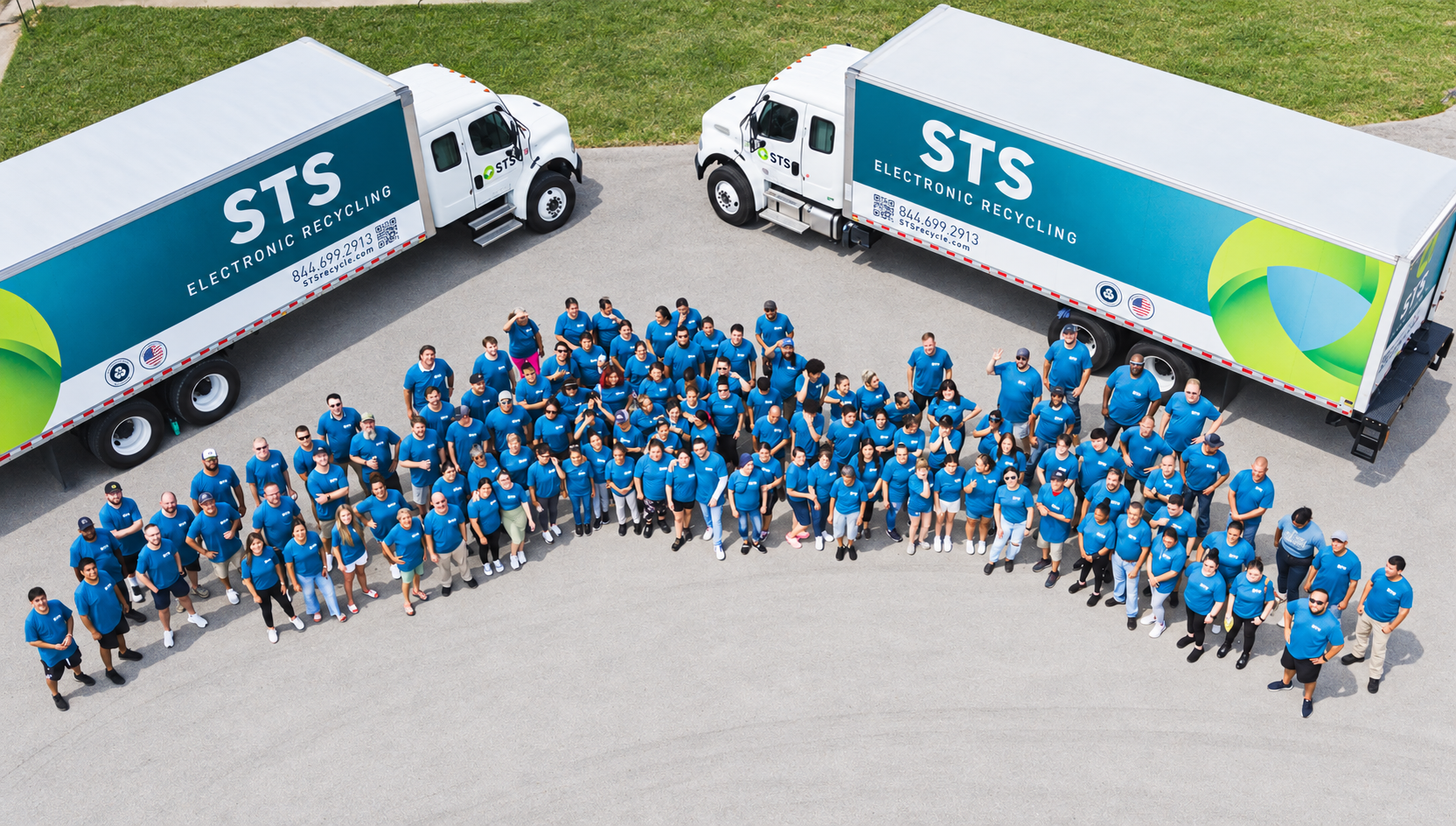
Ready to Build a Compliant IT Disposal Program for Your Irving Agency?
STS Electronic Recycling provides certified and sustainable services for Irving TX government agencies, school districts, and public entities. Serving Irving from our 250,000 sq ft facility, with NIST 800-88 documentation, serialized certificates, mobile on-site shredding, and Texas cooperative purchasing eligibility.