Austin Financial Services IT Compliance Guide

Why Do Austin Financial Services Organizations Need Specialized IT Disposal?
If you're managing IT assets at Dell Technologies (13,000 Austin employees), IBM Austin, or any of the banks, credit unions, and fintech firms driving Austin's Silicon Hills economy, the stakes for improper device disposal go well beyond an IT inconvenience. A single improperly retired server can trigger an FTC Safeguards Rule investigation, expose your organization to GLBA enforcement penalties reaching $100,000 per day, and create SOX Section 404 documentation failures that external auditors will flag immediately.
Austin's financial services sector is anchored by major employers including Dell Technologies (13,000 Austin employees), IBM Austin (approximately 6,000 employees), and Randolph-Brooks Federal Credit Union, the largest credit union in Texas with more than 1 million members. Together with hundreds of Silicon Hills fintech firms, these organizations generate significant IT equipment turnover requiring certified digital asset disposal. According to IBM's 2024 Cost of a Data Breach Report, financial services averages $6.08 million per breach.
The revised FTC Safeguards Rule under GLBA 16 CFR Part 314, which took full effect June 9, 2023, imposes written program requirements that explicitly include IT asset disposal procedures. Austin financial organizations now face layered obligations: federal GLBA requirements, SOX documentation standards for public companies, and PCI DSS requirements for any organization processing payment card data.
The Mistake Most Financial IT Directors Make
Treating IT disposal as a one-time project rather than a continuous compliance obligation. By the time a GLBA examination demands documentation, disposal records from 18 months prior are missing or non-compliant. This guide helps Austin organizations build a proactive ITAD program before an audit forces the issue.
What Compliance Requirements Apply to Austin Financial Services IT Disposal?
Under the FTC Safeguards Rule (16 CFR Part 314), financial institutions must implement a written information security program that includes specific disposal requirements for customer information stored on electronic media. Per FTC amendments effective May 2024, GLBA-covered institutions must also report breaches affecting 500 or more consumers to regulators within 30 days of discovery. For Austin financial organizations, certified Austin data destruction services provide the documentation framework these obligations require.
GLBA Safeguards Rule Requirements for IT Asset Disposal
The revised FTC Safeguards Rule imposes specific disposal requirements under 16 CFR §314.4(f). When retiring computers, servers, or mobile devices that stored or processed customer financial information, federal law mandates a documented disposal framework:
- Written disposal procedures in your information security program -- Required under GLBA 16 CFR §314.4(f)(3). Verbal practices without documentation do not satisfy FTC examination requirements.
- NIST 800-88 Rev. 1 compliant data sanitization -- Software wiping must meet Purge or Destroy level for any media that stored customer financial information.
- Serialized destruction certificates per device -- Listing manufacturer, model, serial number, destruction method, date, and technician ID. Generic batch receipts do not satisfy SOX or FTC requirements.
Austin financial compliance officers typically require chain of custody and accurate reporting certified vendors with serialized per-device certificates. Anything less creates documentation gaps SOX auditors and FTC examiners flag immediately.
Texas State Regulations Layered Over Federal Requirements
Texas-chartered financial institutions face additional scrutiny: the Texas Department of Banking reviews IT security programs including disposal documentation, and Texas ranks first nationally in financial services employment with 648,000+ workers. Gaps found at the state level create dual enforcement exposure alongside federal FTC and OCC oversight.
GLBA Compliance Checklist: Required Disposal Program Elements
Written disposal procedures covering all media storing customer financial information. NIST 800-88 Purge-level sanitization for reusable media. Chain-of-custody documentation through final destruction. Certificates retained minimum three years. Annual review. Current chain of custody and accurate reporting vendor verification before any asset transfer.
How Should Austin Financial Organizations Evaluate ITAD Vendors?
Financial IT Directors at Austin banks, credit unions, and investment firms face a specific challenge: vendors claiming financial sector ITAD expertise rarely hold current chain of custody certification, secure data destruction accreditation, and GLBA-specific documentation that FTC examiners expect. Organizations like Charles Schwab, headquartered in Westlake in the Austin metro, require this standard from every ITAD vendor. Here is how to evaluate compliant vendors.
Non-Negotiable Certifications for Financial ITAD
Do not accept vague certification claims. Require verified documentation with current dates:
Chain of Custody
Why it matters for financial services: Transparent processing ensures downstream tracking through certified processors, protecting Austin financial institutions from downstream liability. Verify current certification at sustainableelectronics.org. Expired certifications are common and create compliance exposure.
Secure Data Destruction
Why it matters for GLBA: FTC investigators recognize accurate reporting on data destruction as evidence of good-faith GLBA compliance during examinations. Verify at naidonline.org and confirm the specific scope, plant-based destruction, mobile destruction, or both. Your requirement determines which you need.
Facility Size and Financial-Specific Capabilities
A vendor with a small warehouse cannot handle enterprise-scale technology refreshes. When Dell Technologies or IBM Austin refreshes equipment across multiple campuses, you need serious processing capacity. Organizations searching for certified IT disposal near me throughout Austin find STS provides scheduled pickup in Round Rock, Cedar Park, and throughout Travis County along the I-35 corridor. For Austin hard drive shredding and full ITAD services, STS serves the greater Austin metro from our 250,000 sq ft certified processing facility.
Ask these specific questions before committing to a vendor:
- Facility square footage: Anything under 100,000 sq ft suggests limited capacity for enterprise financial clients
- Written GLBA-aligned disposal procedures: Any vendor that cannot produce these in writing is immediately disqualified
- Mobile shredding trucks: For witnessed on-site destruction at your Austin or Travis County location
- Serialized certificate format: Request a sample certificate before signing any agreement
Legitimate ITAD vendors provide written pricing before any site visit. Request itemized rates for standard pickup, witnessed on-site destruction, and emergency service before committing.
Financial IT Directors typically prioritize chain-of-custody standards, secure data destruction, and GLBA-aligned documentation over pricing when selecting Austin IT asset disposition providers.
The Insurance Verification Most Financial Teams Skip
Request a Certificate of Insurance showing minimum $5M cyber liability and $2M general liability. If a vendor claims they do not need that level of coverage for financial sector data, walk away. Non-negotiable for financial ITAD in Texas.
How Do Austin Financial Organizations Build a Compliant IT Disposal Program?
When should a Financial IT Director build a GLBA disposal program? Before a GLBA examination triggers a finding, not after. Here is how mature Austin organizations structure their approach using Austin ITAD services as the foundation:
Phase 1: Policy Development (Weeks 1 to 2)
FTC examiners and SOX auditors verify written IT asset disposal policies first under GLBA 16 CFR §314.4(f). Minimum documentation required:
- Who authorizes equipment for disposal and the required approval chain
- Financial data risk classification for different asset types and corresponding destruction requirements
- Retention periods for disposal certificates, minimum three years for GLBA, longer for SEC-regulated organizations
Phase 2: Vendor Selection and Pilot (Weeks 3 to 10)
Request proposals from at least three vendors covering estimated volumes, asset types, Travis County locations, and special requirements. Before committing to a multi-year contract, run a pilot with 25 to 50 units from a single location. Evaluate certificate quality, response times, and whether destruction methods match your GLBA data classification requirements.
Phase 3: Implementation and Ongoing Review
Once validated, lock in pricing for 12 to 24 months. Call 512-340-7393 to schedule a free same-week assessment. Build quarterly business reviews into your program and train staff on disposal procedures for all equipment types.
The Recurring Audit Problem Most Programs Miss
SOX auditors and FTC examiners request disposal documentation from 12 to 24 months prior. Build quarterly review cycles and retain serialized certificates for every engagement. A single undocumented disposal event can create a material weakness finding.
Which Data Destruction Methods Are Required for SOX and GLBA-Compliant IT Asset Disposal?
Wondering which data destruction method your Austin financial organization actually needs? Here is what each method does, what GLBA 16 CFR §314.4(f) requires, and when each applies for financial sector IT assets:
Software-Based Wiping (NIST 800-88 Rev. 1)
According to NIST SP 800-88 Rev. 1 guidelines, media sanitization requires verification at the Clear, Purge, or Destroy level, with Purge the minimum standard for financial data on reusable media. For financial organizations, Clear-level is insufficient for any media that stored customer financial information. Purge level minimum is required, which means:
- Functioning drives destined for asset recovery or redeployment: Purge-level overwrite with cryptographic verification logs
- Any device that accessed customer financial data through your network: Purge-level minimum with serialized certificate
Critical limitation for financial IT: Wiping only works on functioning drives. A workstation that has failed and will not boot cannot be software-wiped. Attempting to document a wipe on non-functional media creates a false certificate that creates direct GLBA and SOX liability.
Degaussing (Magnetic Erasure)
Degaussers create powerful magnetic fields that render drives completely inoperable. For Austin financial organizations, degaussing is appropriate for:
- Failed drives that cannot be software-wiped, common in high-volume financial transaction servers
- Financial archiving servers, tape backup systems, and any magnetic media per your information security policy
Critical note: Degaussing does not work on solid-state drives. Modern financial workstations, laptops, and mobile devices use SSDs exclusively. For these, physical shredding is the only compliant destruction method.
Physical Shredding (Required for High-Density Financial Data Assets)
Industrial shredders reduce drives to particles below any reconstruction threshold. Two delivery methods are available:
Plant-Based Shredding
Drives transported to our 250,000 sq ft certified processing facility and shredded with full chain-of-custody maintained throughout. More economical for large volumes. Serialized destruction certificates issued per device. Documented chain of custody satisfies GLBA and SOX requirements.
Mobile Shredding
Truck-mounted shredder comes directly to your Austin or Travis County location. You witness destruction in real time, the gold standard for ultra-sensitive financial data assets. Required by some financial compliance programs for server decommissions. Eliminates chain-of-custody risk entirely for your highest-exposure equipment.
The Tiered Strategy That Balances Compliance and Cost
Most Austin financial organizations use a tiered approach: NIST Purge wiping for roughly 60% of equipment, degaussing for 20% covering failed drives and magnetic media, and physical shredding for 20% covering servers, SSDs, and high-density customer data assets. This balances GLBA compliance with budget reality.
What IT Disposal Mistakes Do Austin Financial Organizations Make?
STS Electronic Recycling provides certified and transparent IT asset disposition for banking and financial industry IT disposal throughout Austin and Travis County, from the Silicon Hills corridor to Round Rock. Services include NIST 800-88 compliant data sanitization and serialized destruction certificates meeting GLBA 16 CFR §314.4(f) requirements. These are the recurring failures that trigger FTC examinations:
Mistake #1: No Written Disposal Policy
GLBA 16 CFR §314.4(f)(3) requires written disposal procedures. "We always wipe drives before disposal" is not a compliant written procedure. FTC examiners and SOX auditors request your written information security program, and disposal procedures must be a documented component. Organizations operating without written disposal policies are in direct violation regardless of what they do in practice.
Mistake #2: Accepting Batch Certificates Instead of Serialized Documentation
A certificate stating "200 computers destroyed on [date]" is not GLBA-compliant documentation. When the FTC investigates a breach and asks you to prove a specific device was destroyed, a batch certificate proves nothing. Require serialized certificates of destruction, one per device, listing manufacturer, model, serial number, destruction method, date, and technician ID. Anything less is a documentation gap that becomes liability in an examination.
Mistake #3: Transferring Assets Before Verifying Vendor Certifications
The most dangerous mistake in financial ITAD: allowing assets to transfer to a vendor whose chain of custody or secure data destruction certifications have lapsed. Verify current certification status at sustainableelectronics.org and naidonline.org before every engagement. Certifications lapse, companies get acquired, and scopes change. A single transfer to an uncertified vendor creates documentation exposure regardless of what happens to the equipment.
Mistake #4: Ignoring Portable Media and Mobile Devices
USB drives, smartphones, and laptops carry the same GLBA disposal obligations as a data center server. Every device that accessed your financial systems via VPN, mobile app, or network connection requires documented, certified destruction. These assets are frequently overlooked in programs that focus only on scheduled server and workstation refreshes.
Mistake #5: No Vendor Contingency Plan
Maintain relationships with two qualified vendors: a primary handling the majority of volume and a backup that is periodically engaged. Travis County financial organizations cannot pause GLBA-compliant disposal while sourcing an emergency replacement. Both vendors must be pre-verified with current certifications before you need the backup.
The Small Quantity Compliance Gap
Most vendors prioritize large pickups of 50 or more units. Small-quantity disposals (a branch with three retired laptops, an IT team with one failed server) create documentation gaps examiners find immediately. Establish quarterly staging protocols where departments accumulate small quantities to a central location. This creates vendor-friendly volumes while maintaining serialized certificates for every asset.
Related Austin Services
Core ITAD Services
Support Services
Industry Solutions
About This Guide
This compliance guide was developed by the STS Electronic Recycling team based on direct experience serving financial institutions, fintech companies, credit unions, and enterprises throughout Austin and Travis County. STS holds chain of custody and secure data destruction certifications and has processed financial sector IT assets for GLBA-regulated organizations for over a decade. Content reviewed by Mark Domnenko, AI Strategy Consultant.
About STS Electronic Recycling
Where your equipment is processed.
STS Electronic Recycling, Inc. is headquartered in Jacksonville, Texas, and has served schools, businesses, healthcare systems, and government agencies across all 50 states since 2011.
Equipment collected in Austin is staged locally and transported to one of our two R2v3 certified processing facilities in Jacksonville, Texas and Houston, Texas, where all data destruction and material recovery takes place.
Collection, transport and processing are staffed by STS crews rather than subcontracted to a third-party carrier, which is why the chain of custody holds from your dock to the certificate.
View all STS locations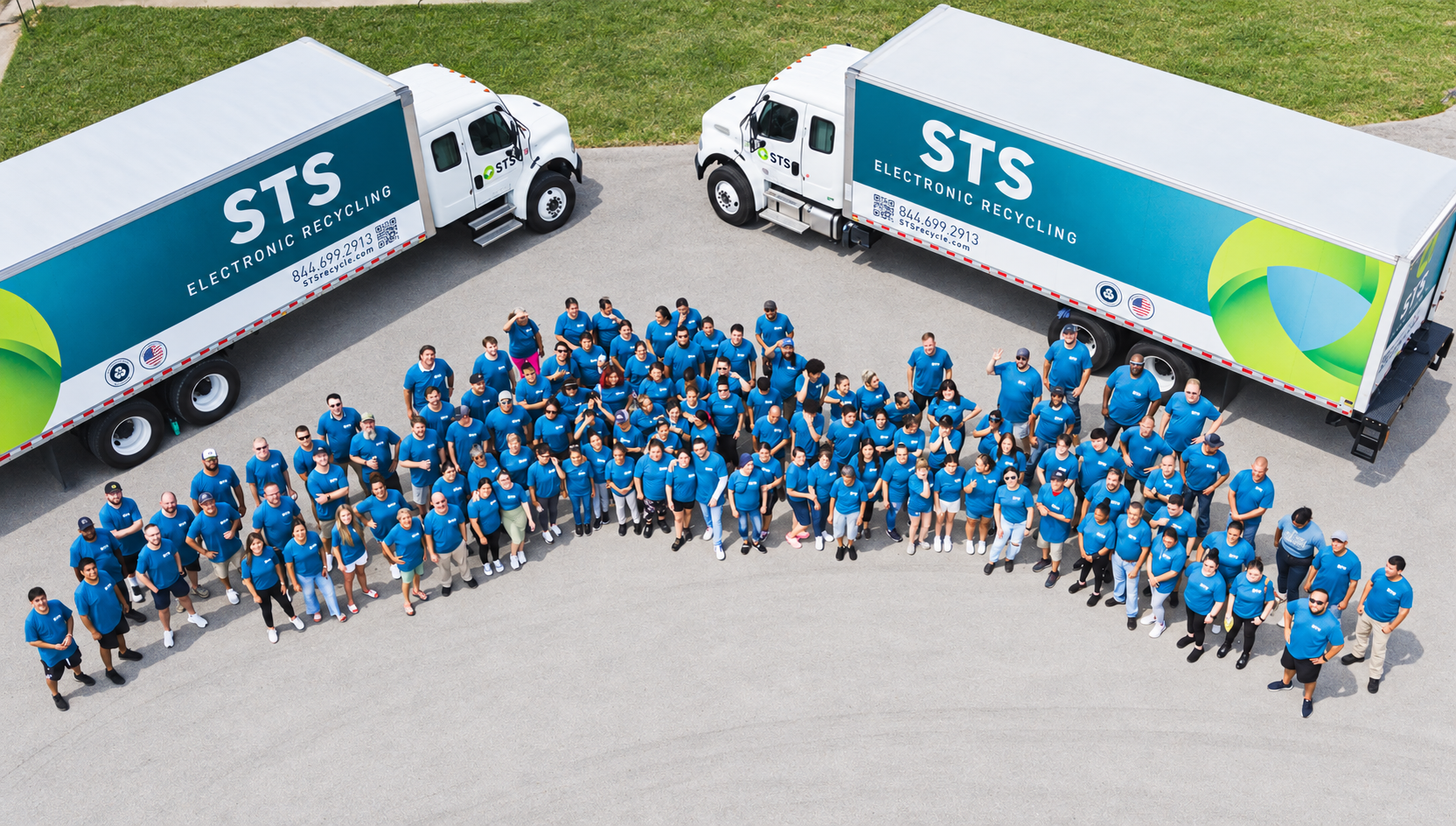
Ready to Implement SOX and GLBA-Compliant IT Asset Disposal in Austin?
STS Electronic Recycling provides certified, transparent ITAD for Austin financial services organizations. Our 250,000 sq ft facility serves Travis County and the greater Austin metro with same-week pickup, witnessed destruction, and serialized compliance documentation.
This email address is being protected from spambots. You need JavaScript enabled to view it. | Contact